

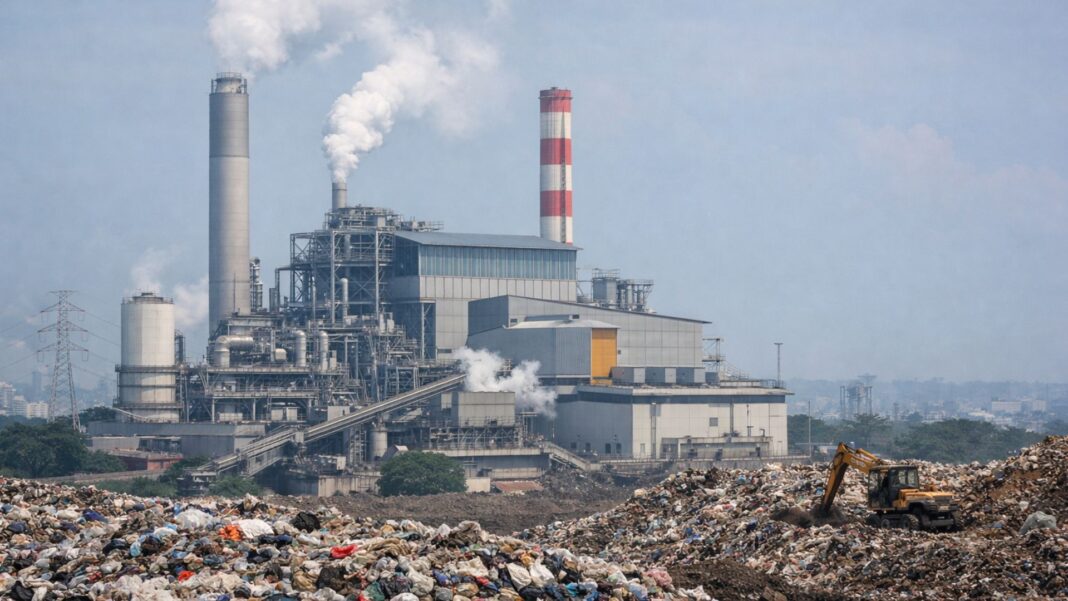

Indonesia’s sovereign wealth fund PT Danantara Investment Management opened a second registration round for its national waste-to-energy program on March 17, 2026, weeks after awarding Phase One contracts for facilities in Bekasi, Denpasar, and Bogor Raya to two Chinese firms whose combined project value reaches nearly USD 600 million. The second round expands eligibility to all domestic and international companies with proven waste-to-energy expertise, widening a pool that in Phase One was drawn almost entirely from Chinese investors.
Key Facts At A Glance
- PT Danantara Investment Management opened the second registration round for its Waste-to-Energy program, known locally as PSEL, on March 17, 2026.
- Phase One contracts for facilities in Bekasi, Denpasar Raya, and Bogor Raya were awarded to Chinese firms Wangneng Environment Co., Ltd. and Zhejiang Weiming
- Environment Protection Co., Ltd., with a combined investment value of nearly USD 600 million (approximately IDR 10.2 trillion).
- Groundbreaking on Phase One facilities is scheduled for the third quarter of 2026, with construction targeted for completion in the fourth quarter of 2027.
- The full 33-city program carries a total price tag of approximately IDR 84 trillion, or approximately USD 5 billion.
- All winning operators are required to form consortia with Indonesian companies, whether private, state-owned, or regionally owned, to facilitate technology transfer and local capacity development.
- PT PLN, Indonesia’s state power utility, is required to purchase waste-to-energy electricity at a fixed tariff of USD 0.20 per kilowatt hour under Presidential Regulation No. 109/2025, providing revenue certainty for project operators over 30-year concession terms.
- The expression of interest submission window for the second registration round runs from March 25 to April 25, 2026. Virtual technical discussion sessions are scheduled for March 26 and April 1, 2026.
- Danantara Chief Investment Officer Pandu Sjahrir has set a target to speed up rollout across 33 cities as a priority for 2026.
Program Background And Regulatory Framework
Indonesia’s waste-to-energy initiative is governed by Presidential Regulation No. 109/2025, which formally tasks Danantara Indonesia with leading the integrated development and management of waste-to-energy facilities, known as PSEL projects, across Indonesia’s major urban centres. The regulation establishes a fixed feed-in tariff of USD 0.20 per kilowatt hour for electricity sold to PLN under 30-year power purchase agreements, a structure designed to provide the revenue predictability necessary to attract private capital to a historically difficult infrastructure sector.
The programme formalises a shift in how Indonesia approaches its urban waste emergency. For decades, the country relied on a collect-transport-dispose model that has become structurally inadequate as urban populations expanded and per-capita waste volumes grew. Danantara’s involvement centralises investment coordination and project governance in a single institution, removing the fragmented municipal financing model that previously caused repeated project delays.
Danantara Investment Director Fadli Rahman described the intent of the programme as addressing Indonesia’s national waste challenge while simultaneously building a modern, diversified energy infrastructure base.
Phase One: Awards And Chinese Dominance
The first phase of the programme focused on four cities meeting readiness criteria: Bekasi, Denpasar Raya, Bogor Raya, and Yogyakarta. Danantara shortlisted 24 companies from more than 100 to 120 expressions of interest received during the October 2025 solicitation phase. Of those 24 shortlisted firms, the majority were Chinese companies.
Danantara announced the Phase One winners in early March 2026. Wangneng Environment Co., Ltd. was selected as managing partner for the Bekasi project, with a planned facility capable of processing 1,500 tonnes of waste per day under a 30-year concession. Zhejiang Weiming Environment Protection Co., Ltd. won the contracts for the Denpasar Raya and Bogor Raya projects. The combined investment value of the three awarded contracts is nearly USD 600 million. Local partners for each winning consortium are yet to be formally announced, with Danantara confirming those disclosures are expected as the projects move into final licensing.
Danantara Chief Investment Officer Pandu Sjahrir said the selected operators are expected to maintain consistent operational performance, comply with applicable regulations, and sustain engagement with surrounding communities. Per the regulatory framework, each winning consortium must include a domestic Indonesian partner, with Fadli Rahman noting that companies from outside the waste sector, including coal companies with thermal installation experience, are eligible as local partners.
The Yogyakarta contract award had not been publicly confirmed in available sources at the time of publication. Publicly available information on that specific award remains limited.
Second Registration Round: Expanding The Pool
Following the Phase One awards, which were dominated by Chinese investors, Danantara opened a second registration round on March 17, 2026, aimed at broadening both the technology base and the sources of financing for subsequent phases. The second round covers nine additional cities and is expected to produce winners in mid-2026.
Fadli Rahman stated that the decision to reopen the registration process reflects Danantara’s objective to attract capital and technology from a wider range of countries. Companies previously included in the Phase One Verified Provider List are not required to re-register unless they wish to apply as part of a new consortium. All other domestic and international companies established in Indonesia or in countries maintaining diplomatic relations with Indonesia are eligible to apply.
The expression of interest submission window opened March 25 and runs until April 25, 2026. Danantara is conducting two rounds of virtual technical discussion sessions, scheduled for March 26 and April 1, 2026, each with multiple sessions to accommodate participants from different time zones and regions.
Programme Scale And Investment Structure
The full 33-city rollout carries a total estimated cost of approximately IDR 84 trillion, equivalent to approximately USD 5 billion. Each individual facility requires an estimated investment of between IDR 2.3 trillion and IDR 3.2 trillion, depending on the technology selected. Each plant is designed to process a minimum of 1,000 tonnes of waste per day and generate electricity for approximately 20,000 households.
Funding for the programme draws on multiple sources, including proceeds from Danantara’s Patriot Bonds, which target a raise of up to IDR 50 trillion or approximately USD 3 billion, alongside direct Danantara capital deployments and private investment from selected consortium partners.
PT Sarana Multi Infrastruktur, a Special Mission Vehicle under Indonesia’s Ministry of Finance, confirmed in March 2026 that it is in discussions with Danantara about potential collaboration on future phases of the waste-to-energy programme. PT SMI has issued its first tranche of Sustainable Bond I Phase II 2026 retail bonds, with proceeds earmarked for green and social projects, signalling the availability of domestic blended finance instruments to support programme expansion.
Governance And Delivery Risks
The programme’s governance structure requires Danantara to coordinate simultaneously with the Ministry of Energy, state utility PLN, regional governments, and private operators. Coordinating Minister for Food Affairs Zulkifli Hasan said in March that the Presidential Regulation framework is designed to shorten decision-making timelines by allowing contracts to be handled directly between Danantara, PLN, and the energy ministry.
Fitch Ratings downgraded Indonesia’s sovereign debt outlook from stable to negative on March 4, 2026, citing concerns over policy uncertainty and the state budget deficit. In its assessment, Fitch highlighted uncertainty over whether Danantara’s mandate could expand over time to encompass quasi-fiscal activities through leveraged investments, a signal that international credit markets are monitoring the fund’s governance trajectory closely.