

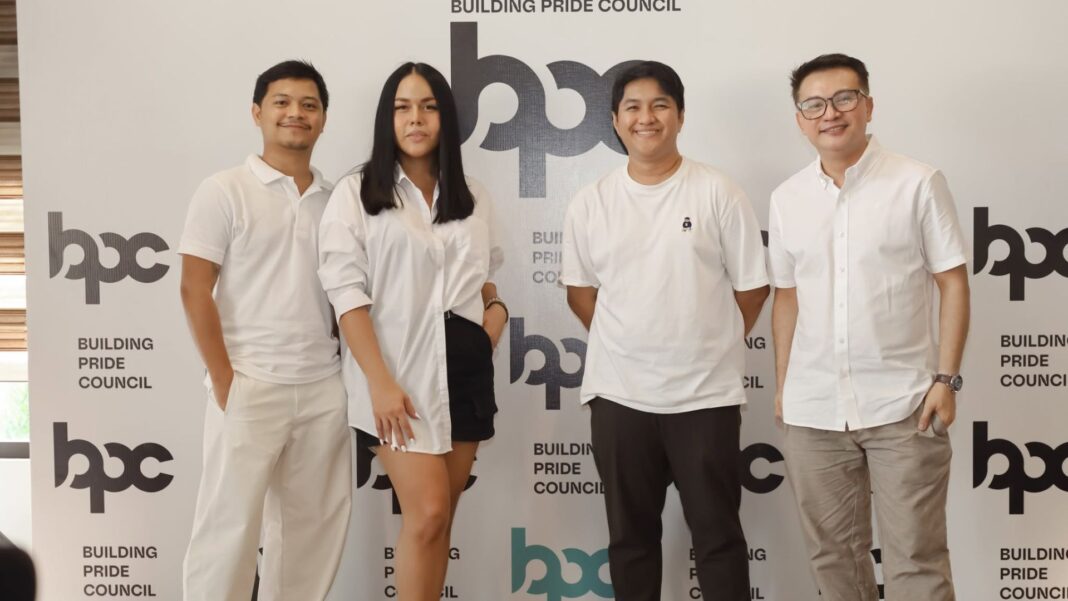

The built environment sector, long associated with blueprints, steel beams, and construction deadlines, is now laying the groundwork for something less tangible but arguably just as foundational: an industry-wide advocacy movement for diversity and inclusion.
The newly established Building Pride Council (BPC), a Securities and Exchange Commission-registered, nonstock, nonprofit professional association, is positioning itself as proof that even the most technical, output-driven industries can carry a social advocacy at their core, not as an afterthought, but as an organizing principle.
The Council brings together architects, engineers, interior designers, developers, contractors, manufacturers, suppliers, planners, project managers, consultants, and allied professionals under one platform. Its explicit purpose is to advance diversity, professionalism, innovation, and collaboration across construction, building, engineering, architecture, and design, while creating space for LGBTQIA+ professionals and allies within an industry that has not always made room for them.
“The strongest foundations are built not only with concrete and steel, but with integrity, collaboration and people who are empowered to lead,” said Karlo Calleja, founder and chairman of the BPC. “Our vision is to unite professionals across disciplines, celebrate diversity, strengthen industry partnerships, and create a built environment where everyone has the opportunity to thrive and contribute.”
Advocacy As Infrastructure
What sets the BPC apart from a typical professional guild is how deliberately it treats advocacy as part of its actual programming, not a side initiative. Alongside networking events, industry forums, and learning sessions, the Council has committed to rolling out dedicated advocacy campaigns and strategic partnerships aimed at promoting inclusive growth throughout the Philippine construction and building industry, with an eye toward eventually expanding into the wider Asia-Pacific region.
This structure is reflected in its own leadership roster. The Council was founded by Calleja alongside Harvin Julius Lasquero, founding director for Research, Innovation and Knowledge; Bejay Florendo, founding director for Membership and Professional Development; and John Carlo Lopez, who holds the title of founding director for Advocacy and Policy, a role that signals how central the cause is meant to be to the organization’s identity rather than a function bolted onto a trade association.
In effect, the BPC is arguing that inclusion and industry excellence are not competing priorities. A more diverse pipeline of architects, engineers, and designers, the group suggests, is also a stronger and more innovative one, better equipped to serve a built environment shaped by a wide range of communities and needs.
Recruiting The Movement, Not Just The Members
True to its self-description as “more than an organization,” the BPC’s launch phase reads like the opening move of a sustained advocacy campaign rather than a one-time announcement. The group is actively building out its Founding Board of Directors, with open seats for a mechanical engineer, an electrical engineer, an electronics and communication engineer, and an interior designer, and it has opened membership to licensed professionals, students, and aspiring practitioners across the built environment.
It is also inviting organizations, institutions, and companies that share its vision to come on board as strategic partners, a move that extends the advocacy beyond individual professionals and into the realm of institutional buy-in, the kind of partnerships that tend to give grassroots-style movements staying power.
Whether the BPC’s advocacy campaigns translate into measurable shifts in hiring, workplace culture, or industry policy will depend on execution in the months ahead. But its founding structure, an advocacy-and-policy directorship sitting alongside research and membership functions, suggests the Council intends its social mission to be as load-bearing as any technical standard the industry upholds.
As Calleja put it, summarizing the Council’s broader ambition: “Together, we are building more than structures; we are building leadership, opportunity, inclusion and lasting impact.”