

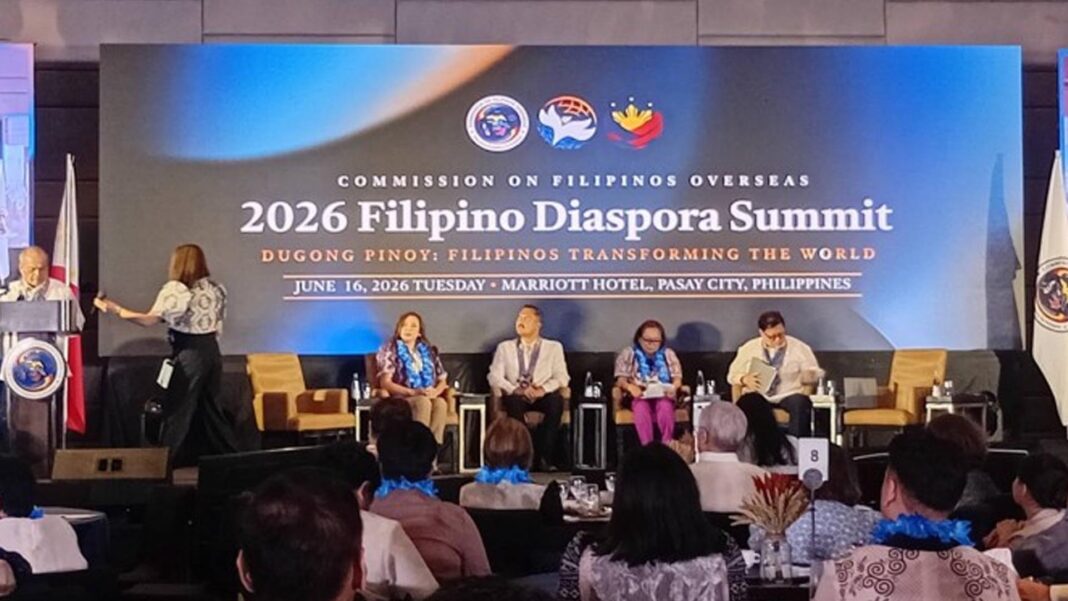

For more than 6 million non-resident Filipinos (NRFs) across the globe, it is not always about “successfully making it outside the Philippines,” as many face the greater challenge of finding a sense of belonging while trying to preserve their Filipino identity.
In a panel discussion during the 2026 Diaspora Summit in Pasay City on June 17, Filipinos who successfully penetrated politics said that in ensuring that their voices are heard in the countries they now call home, realities took center stage, reflecting the evolving role of overseas Filipinos, not merely as workers and migrants, but as advocates, community builders, and political actors.
Filipino leaders from Guam, Hawaii, Europe, Australia, and the United States discussed during the summit the daily nuisances that NRFs, including the present generations, quietly endure.
Despite having made it in the country they now call home, these leaders spoke about identity, acceptance, and the search for belonging.
Behind their success stories as elected officials, entrepreneurs, and community leaders were accounts of uncertainty familiar to many migrants: the feeling of being too foreign in their adopted countries and, sometimes, not Filipino enough when they return home.
For Walter Villagonzalo, a Filipino-Australian community leader, social entrepreneur, and former Councilor and Deputy Mayor of Wyndham City in Victoria, Australia, the experience of migration often places Filipinos in what he calls “the middle,” which means accepted enough to contribute, but not always visible enough to influence decisions.
“We work hard, we adapt quickly, we speak English, we fit in, we contribute quietly and steadily. Filipinos are strong contributors, but we are not always visible. We are leaders in our own Filipino communities, but not always in the wider public,” he said.
After migrating to Australia, Villagonzalo said that he struggled to find his place, but having this overwhelming feeling, he eventually returned to the Philippines with his family “because I did not feel I belong.”
Villagonzalo said he brought his family back to the Philippines, stayed for 10 months, and later told them they were not going back to Australia, as this is “where I belong.”
However, his children saw things differently.
Crying, they wanted to return to Australia, which forced him to confront a difficult reality: the place he had considered temporary had already become home.
Years later, he said he found acceptance, not through status or professional success, but through community service, where he felt a sense of belongingness.
“I’m a second-class citizen, but it is what it is. We’re there in another country. It’s not the Philippines,” he said.
Villagonzalo’s story resonated because it reflected a dilemma shared by many migrants: leaving home in a day, and spending years trying to fit in the new country.
This challenge is even more complicated for younger generations born or raised overseas.
Maria Zelda Rojas of the European Network of Filipino Diaspora (ENFID), based in Austria, described the experience through her daughter’s eyes.
She said that given the supposed semi-identity crisis, it was harder to feel connected to being Filipino “because you’re surrounded by non-Filipino friends,” citing “biculturalism.”
“I have a daughter who is 23. In Vienna, she is Viennese, but she’s not really accepted as a Filipino. She comes home, she’s a Filipino. But she’s not really seen as a Filipino,” she said.
Larry Asera, former Deputy Secretary of State of California, an engineer and a businessman, on the other hand, said that he is the kind of “interesting diaspora,” not only because he is a third-generation migrant, but also because he grew up as a Filipino-American in the US.
He shared that at home, he is a Filipino with Ilocano grandparents on one side and Visayan on the other.
“So, which dialect do we speak? They said, speak English,” he said.
Back in the 1940s and 1950s, he said, the elders did not want him to have an accent. But once he steps out of the house, he has to be like “others” and be better than them.
Children of migrants often grow up navigating multiple identities at once.
They may speak little Filipino, celebrate different traditions, or feel stronger ties to the countries where they were born or raised, and yet, their appearance, family history, or even surname, would frequently remind them of their roots and heritage, which may result in a lingering sense of being “in the middle” and caught between worlds.
However, for diaspora leaders, this dual identity is increasingly being viewed as a strength rather than a liability.
Honolulu City Council member Tyler Dos Santos-Tam, a fifth-generation Filipino-American, said younger Filipinos bring perspectives shaped by both their heritage and the societies where they grew up.
He said the younger generation of NRFs can now move comfortably between cultures, enabling them to build connections that earlier generations often struggled to form.
“Solidarity with other immigrant groups is also key,” he said.
Villagonzalo described Filipinos as “natural bridge builders,” a trait, which he believes, comes from decades of adapting to new environments while maintaining ties to their roots, adding that Filipinos in the middle is not a problem.
He said that Filipinos abroad know this place very well, but they don’t always notice it; they are simply working, adjusting, and contributing.
“The middle is not a weak place. It is a place of connection. It is where trust grows. It is where cultures meet. It is where bridges are built,” Villagonzalo said.
“Filipinos are natural bridge builders. We connect cultures at work. We connect communities in the countries we now call home, and we can do even more. We can build links between the Philippines and the countries where we now live.” (PNA)