

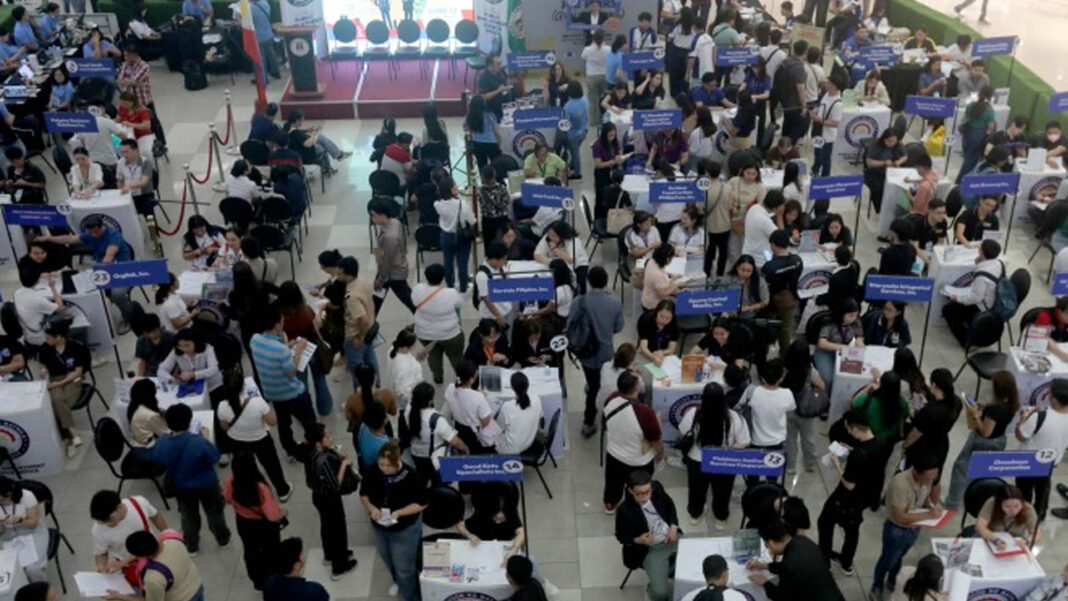

The Department of Labor and Employment (DOLE) vowed to continue strengthening employment facilitation and connecting job seekers with available opportunities.
This came after the July 2026 Labor Force Survey (LFS) results released on Tuesday showed both gains and continuing challenges in the labor market.
“Employment remains significantly higher than a year ago, but the increase in unemployment reminds us that there are Filipinos who continue to seek work. We will continue strengthening employment facilitation and connecting job seekers with available opportunities,” Labor Secretary Francis Tolentino said in a statement.
According to the latest LFS released by the Philippine Statistics Authority (PSA), the number of employed Filipinos reached 49.21 million in July 2026, with several key sectors of the economy recording employment gains over the year.
The department noted that employment increased by 3.16 million from 46.05 million in July 2025, reflecting continued employment activity across major sectors of the economy.
On the other hand, Tolentino also noted that the sectoral movements reinforce the importance of keeping employment services responsive to changing labor demand.
“We need to closely monitor where employment opportunities are growing and where gaps remain so that our employment programs and services can respond to the needs of workers and job seekers,” he said.
The LFS results also showed that the country’s labor force increased by 3.71 million year-on-year to 52.36 million, raising the labor force participation rate from 60.7 percent to 63.6 percent.
The employment rate, however, declined to 94.0 percent from 94.7 percent in July 2025, while the unemployment rate increased to 6.0 percent from 5.3 percent. The number of unemployed persons rose by 551,000 year-on-year, from 2.59 million to 3.14 million.
Meanwhile, the underemployment rate declined to 12.9 percent in July 2026 from 14.8 percent in July 2025. The number of underemployed persons likewise decreased by 473,000 year-on-year to 6.33 million. However, on a month-on-month basis, underemployment increased by 214,000, while the rate rose from 12.1 percent in June to 12.9 percent in July.
Meanwhile, youth labor force participation rose to 33.7 percent in July 2026 from 29.5 percent in July 2025, while the youth NEET rate declined to 15.2 percent from 15.9 percent. However, youth unemployment increased to 18.6 percent, from 18.1 percent year-on-year and more sharply from 13.5 percent in June 2026.
To help more Filipinos find work and gain valuable experience, the DOLE said it will continue its youth employability programs, including the Government Internship Program (GIP) and Special Program for Employment of Students (SPES).
Starting this month, the department will also conduct monthly Trabaho Agad job fairs nationwide, with Public Employment Service Offices (PESOs) fast-tracking the placement of applicants, particularly “near-hires” who only need to complete remaining documentary requirements.
It will likewise expand TUPAD assistance for workers and communities affected by floods and monsoon rains, including school readiness activities, waterway clearing, and other community projects, while strengthening its transition toward community-based enterprises through TESDA training and capital support.
The DILEEP/DILP will continue providing livelihood assistance for farming, vending, processing, repair services, and other small enterprises, including workers recovering from habagat-related flooding. Skills-to-work partnership with TESDA and DMW will also be deepened to connect training, starter kits, and capital assistance to jobs or viable enterprises, including for returning OFWs.
The Adjustment Measures Program (AMP) will likewise remain available to help MSMEs manage economic pressures, protect jobs, and improve productivity.
Tolentino also directed DOLE Regional Offices to target areas with the sharpest job losses, coordinate with LGUs and PESOs, and intensify implementation of youth employability programs.
“The goal is not only to bring the unemployment rate down, but to put more Filipinos in decent, more productive work,” he said. (PNA)