


Lao Prime Minister Sonexay Siphandone and Japanese Prime Minister Takaichi Sanae affirmed on June 10, 2026, their commitment to expanding bilateral cooperation in clean and alternative energy, mining, agriculture, and technology as core priorities under the Laos-Japan Comprehensive Strategic Partnership, with Laos explicitly endorsing Japan’s POWERR Asia energy resilience framework launched in April.
Key Facts At A Glance
- Talks took place on June 10, 2026, at the Japanese Prime Minister’s Office in Tokyo, on the sidelines of the 31st Nikkei International Conference on the Future of Asia
- The meeting was the first bilateral summit between Sonexay Siphandone and newly re-elected Japanese Prime Minister Takaichi Sanae, who took office in February 2026
- Both leaders reaffirmed cooperation priorities under the Comprehensive Strategic Partnership (CSP) signed in January 2025, including clean and alternative energy, mining, and modern agriculture
- Prime Minister Sonexay expressed support for Japan’s POWERR Asia framework, launched April 15, 2026, at the AZEC Plus Online Summit on Energy Resilience
- POWERR Asia, backed by approximately USD 10 billion in Japanese financial commitment, covers both emergency energy responses and structural mid-to-long-term resilience measures across ASEAN and partner states
- Japan’s J-POWER and Hazama Ando Corporation entered the Laos hydropower sector in April 2026 through a stake in the 770 MW Pak Lay Mekong run-of-river project
- JICA is co-developing with Laos an Integrated Energy Master Plan for 2030 to 2050, covering the transition beyond hydropower dependence toward a diversified generation mix
Lao Prime Minister Sonexay Siphandone met with Japanese Prime Minister Takaichi Sanae at the Japanese Prime Minister’s Office in Tokyo on June 10, using the margins of the 31st Nikkei International Conference on the Future of Asia as the platform for the first bilateral summit between the two leaders since Takaichi’s re-election in February 2026.
The talks reaffirmed both countries’ commitment to deepening the Comprehensive Strategic Partnership formalized in January 2025, with clean and alternative energy identified alongside agriculture, mining, tourism, and technology as the principal areas for expanded economic cooperation and investment.
The Comprehensive Strategic Partnership: From Document To Delivery
The January 2025 CSP represented a formal upgrade from the strategic partnership the two countries had maintained since 2015. The upgrade coincided with the 70th anniversary of Laos-Japan diplomatic relations and was signed in Tokyo by then-Prime Minister Ishiba Shigeru and Siphandone, with a joint statement committing both governments to elevating cooperation across political, security, economic, and people-to-people dimensions. Energy and decarbonization were named among the priority cooperation sectors, with explicit reference to the Asia Zero Emission Community (AZEC) framework as the regional vehicle for clean energy alignment.
The June 10 meeting under Prime Minister Takaichi, Ishiba’s successor following the February 2026 election, reflects continuity in the CSP’s implementation. Both leaders agreed to further strengthen bilateral relations and enhance cooperation in potential areas including modern agriculture and processing industries, clean and alternative energy, mining, tourism, technology, and other emerging sectors. The meeting produced no new signed instruments, but the reaffirmation of the CSP’s energy cooperation agenda at prime ministerial level carries political weight as Japan positions itself as a leading energy partner for Mekong subregional states.
Laos Endorses POWERR Asia
A substantive element of the June 10 talks was Prime Minister Sonexay’s expressed support for Japan’s POWERR Asia initiative. Sonexay also commended Japan for hosting the AZEC Plus Online Summit on Energy Resilience in April, at which the framework was launched.
POWERR Asia, whose full name is the Partnership on Wide Energy and Resources Resilience Asia, was announced by Prime Minister Takaichi on April 15 at the AZEC Plus Summit. The framework is structured in two tracks: emergency response measures addressing immediate fuel shortages and supply chain stability, and structural measures targeting mid-to-long-term energy resilience. Japan committed approximately USD 10 billion in financial support to participating countries. Participants include the 11 AZEC partner countries, South Korea, India, Bangladesh, Sri Lanka, and Timor-Leste, alongside the International Energy Agency, the Asian Development Bank, and the Economic Research Institute for ASEAN and East Asia.
The initiative was conceived directly in response to the Hormuz disruption. Japan’s Ministry of Foreign Affairs framed the AZEC Plus Summit and POWERR Asia as embodying the evolution of the country’s Free and Open Indo-Pacific strategy to incorporate energy and economic resilience. Laos’ endorsement is notable given that Vientiane simultaneously concluded an intergovernmental nuclear energy agreement with Rosatom in Moscow on June 15, five days after the Tokyo summit, establishing Laos as an active diplomatic participant in energy conversations with both Japan and Russia within the same week.
Japan’s Growing Commercial Footprint In Lao Energy
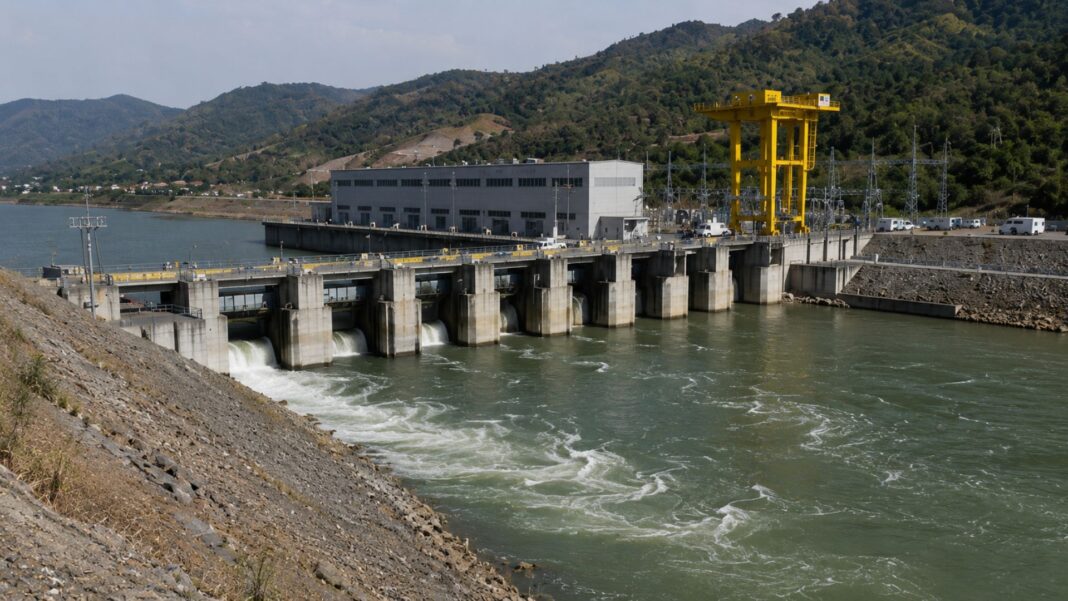
The June summit occurs against the backdrop of an actively expanding Japanese commercial presence in Laos’ power sector. In April 2026, Japan’s J-POWER and Hazama Ando Corporation joined the 770 MW Pak Lay hydropower project on the Mekong River in Laos through their joint venture JH International, marking both companies’ first entry into the Lao hydropower sector. The project is a run-of-river design comprising 14 generating units of 55 MW each, developed in partnership with Thailand’s Gulf Energy. J-POWER brings hydropower operational experience from projects in the Philippines and Indonesia, while Hazama Ando contributes dam construction engineering.
Beyond commercial investment, the Japan International Cooperation Agency (JICA) is working with Laos to develop an Integrated Energy Master Plan covering 2030 to 2050. The IEMP aims to present a long-term energy vision that addresses Laos’ structural vulnerability stemming from its heavy hydropower dependence, which leaves the system exposed to drought-driven generation shortfalls in dry seasons. The plan is designed to chart a transition toward a diversified generation mix incorporating renewable energy beyond hydro, while reinforcing energy sovereignty and industrial development objectives.
Japan has also been a long-standing development finance partner for Laos in power transmission. An earlier JICA ODA loan supported the interconnection of two transmission systems in Laos’ southern region, improving supply reliability in Savannakhet Province, and the Japan-US Mekong Power Partnership (JUMPP), launched in 2019 with JICA as co-implementor, has provided technical assistance to Laos’ power sector on clean energy integration, market development, and regulatory capacity alongside Cambodia, Thailand, and Vietnam.
Strategic Context: Japan, China, And The Mekong Energy Competition
Japan’s deepening energy engagement with Laos is taking place in a market where China holds a structurally dominant position. China Southern Power Grid holds a 90% stake in Électricité du Laos Transmission Company (EDL-T), the joint venture managing Laos’ transmission infrastructure. Two major high-voltage transmission projects advanced in 2026: a 230 kV domestic interconnector breaking ground in January, and a 500 kV cross-border power line between Laos and China’s Yunnan province reaching approximately 86% completion. The latter enables two-way power exchange, allowing Laos to purchase power from Yunnan during dry-season hydropower shortfalls.
Japan’s engagement through ODA, JICA technical cooperation, JUMPP, POWERR Asia, and now direct private investment via J-POWER provides an alternative financing and technical track, focused on grid governance, regulatory capacity, clean energy diversification, and long-term energy master planning. The June 10 summit and Laos’ endorsement of POWERR Asia signal Vientiane’s intent to maintain multiple bilateral energy relationships rather than consolidating exclusively around any single partner.