

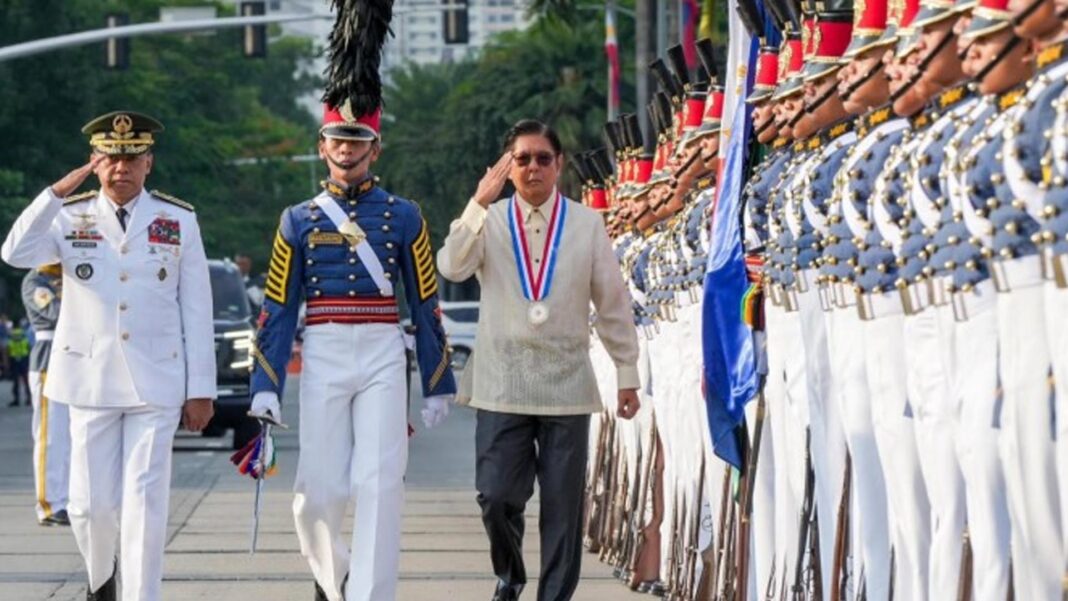

President Ferdinand R. Marcos Jr. showcased a governance agenda anchored on protecting lives, strengthening institutions, and preparing the country for future challenges in a week marked by prompt disaster response and the celebration of Philippine independence.
A devastating magnitude 7.8 earthquake that struck offshore of Sarangani on June 8 set the tone for a week that tested the Marcos administration’s preparedness as it balanced its priorities on resilience, innovation, education, and justice reform.
As the country commemorated the nation’s 128th Independence Day on June 12, the President’s engagements reflected an overarching goal: building a more resilient and future-ready Philippines while addressing the immediate needs of Filipinos.
The week began with an emergency that demanded prompt national attention.
Shortly after the powerful earthquake jolted parts of Mindanao, Marcos ordered concerned government agencies to mobilize resources and implement swift response measures.
He also ordered the temporary suspension of classes at all levels in affected areas, recognizing the potential dangers posed by aftershocks and tsunami threats.
Responding to disaster
On June 9, Marcos presided over a high-level situation briefing at Malacañan Palace in Manila to assess the effects of the earthquake and evaluate the government’s ongoing response and relief efforts.
The briefing convened key officials responsible for disaster management, humanitarian assistance, infrastructure rehabilitation, and public safety.
The President received updates on evacuation efforts, relief distribution, infrastructure damage, and ongoing response measures.
Marcos flew to General Santos City on June 10 to inspect quake-damaged structures, including the St. Elizabeth Hospital, and oversee relief operations on the ground.
During the visit, the Office of the General Santos City Mayor received PHP100 million for the repair of the city hall, while the families of those who died in the earthquake were provided PHP50,000 each.
Marcos vowed continued government assistance for affected residents, reflecting the administration’s efforts to accelerate aid delivery as it maintains a whole-of-government approach during times of crisis.
Investing in learners
Also on June 10, Marcos visited the newly constructed Dao Building and Henry Sy Sr. Hall at the San Francisco High School in Quezon City to inspect facilities rebuilt after a fire in June 2025 that rendered the original structures unusable and nearly condemned.
The Dao Building, originally a two-story building, was redesigned into a four-story structure by the Department of Public Works and Highways and now houses 36 classrooms.
Marcos also led the distribution of educational materials to learners from 13 public schools in San Juan City in a ceremony at the Pinaglabanan Elementary School.
The Office of the President – Office of the Executive Secretary provided about 1,000 school bags filled with essential learning materials for Kindergarten and Grade 1 students through the Socio-Civic Projects Fund, while the San Juan City local government distributed about 13,000 tablets to Kindergarten and Grade 12 learners.
Strengthening maritime security
Acknowledging the need to address emerging threats at sea, Marcos on June 9 attended the 128th Philippine Navy anniversary celebration at Naval Station Jose Andrada Manila.
The event highlighted the Philippine Navy’s commitment to modernization and maritime defense, with the commissioning of the BRP Rajah Lakandula, a significant addition to the fleet.
Marcos emphasized the importance of a strong naval force in protecting the country’s sovereignty and responding to regional security challenges.
He assured Navy personnel of the government’s continued support for their welfare and modernization efforts, aimed at enhancing the country’s ability to safeguard its maritime interests while contributing to regional stability.
Improving the justice system
Amid government efforts to strengthen the country’s justice system, the President led the oath-taking of newly elected prosecutors of the National Prosecution Service (NPS) at Malacañan on June 10.
The ceremony underscored the administration’s continuing efforts to address longstanding concerns over the accessibility and timeliness of justice in the country.
Marcos stressed the importance of further strengthening the NPS and deploying more prosecutors across the country.
The oath-taking formed part of broader reforms aimed at reinforcing institutional capacity within the justice sector and ensuring that legal remedies are more accessible and responsive to the needs of Filipinos.
Faith and cultural tradition
On June 11, the President, along with First Lady Liza Araneta-Marcos, officiated the reception and blessing of the Pilgrim Image of Our Lady of Guadalupe for the Philippine Pilgrimage 2026, reflecting the importance of faith and cultural traditions in the lives of many Filipinos.
The ceremony marked the beginning of a six-month nationwide journey of the sacred image across more than 40 churches, cathedrals, and shrines before its permanent installation at The Manila Cathedral.
The pilgrim image is a replica of the original enshrined at the Basilica of Our Lady of Guadalupe in Mexico and symbolizes deep Marian faith among Filipino Catholics.
The pilgrimage is part of the global Novena Intercontinental Guadalupana and serves as preparation for the 500th anniversary of the apparitions of Our Lady of Guadalupe in 2031.
Other activities at Malacañan
Marcos on June 9 also presided over a meeting on the preparations for the 49th Association of Southeast Asian Nations (ASEAN) Summit, signaling the Philippines’ active role in regional affairs and its commitment to strengthening cooperation among Southeast Asian nations on economic, security, and development issues.
On June 11, he convened the 10th National Innovation Council Meeting to discuss strategies to strengthen innovation-driven growth, enhance competitiveness, and accelerate the country’s digital transformation.
He also received a briefing on preparations for the ASEAN-Russia Commemorative Summit, reinforcing the administration’s efforts to deepen international partnerships and expand opportunities for economic and strategic cooperation.
Celebrating freedom
The week culminated on June 12 with the observance of the country’s 128th Independence Day.
Carrying the theme “Kalayaan, Kinabukasan, Kasaysayan,” the celebration connected the sacrifices of the past with the aspirations of future generations.
Marcos led the traditional flag-raising and wreath-laying ceremony at the Rizal Monument in Luneta.
This was followed by the Independence Day Parade at the Quirino Grandstand, showcasing the participation of various sectors in nation-building and underscoring the country’s continuing commitment to unity and service.
The day’s activities concluded with the Vin d’Honneur at Malacañan Palace, gathering members of the diplomatic corps and government officials in a celebration of friendship and cooperation among nations.
As Filipinos celebrated another year of independence, the week’s events conveyed a broader message: that preserving freedom requires strong institutions, resilient communities, capable public servants, and sustained investments in the nation’s future. (PNA)