
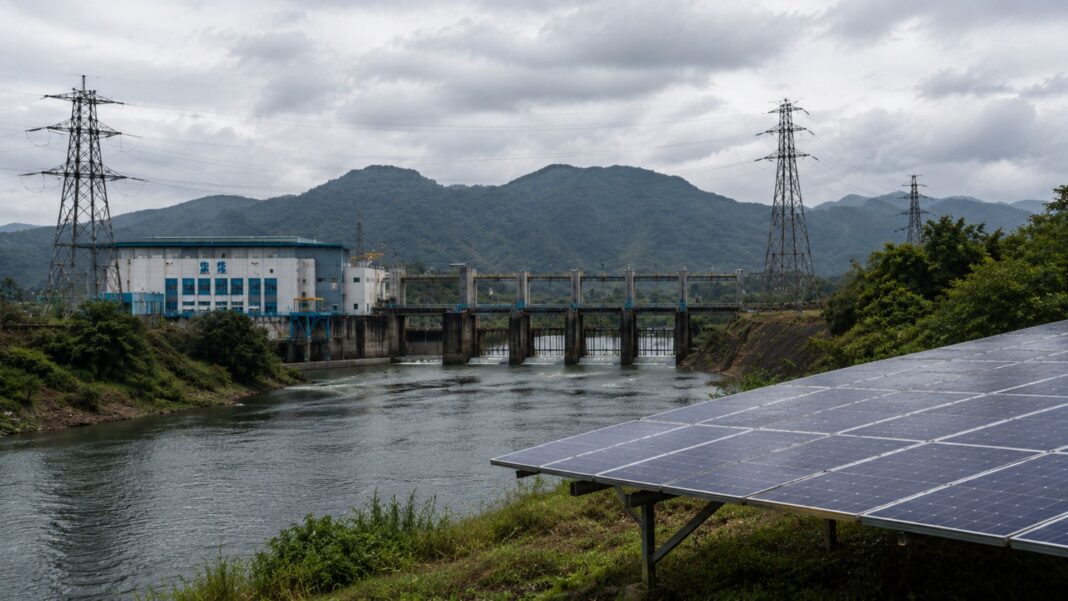

Indonesia’s Ministry of Energy and Mineral Resources disclosed that new and renewable energy accounted for 17.89 percent of the national electricity mix as of April 2026, surpassing the government’s own interim target of 16.46 percent, even as officials cautioned that fossil fuels continue to dominate the country’s power system at scale.
Key Facts At A Glance
- Indonesia’s new and renewable energy (NRE) mix in the electricity sector reached 17.89 percent as of April 2026, against a government target of 16.46 percent for that period.
- The Q1 2026 national energy mix figure was separately reported at 18.3 percent, up from 15.75 percent recorded for full-year 2025.
- Total national electricity production stood at 165.51 terawatt-hours (TWh) as of the April reporting period.
- Hydropower contributed 3.59 percentage points to the national energy mix; biomass power contributed 3.27 percentage points; geothermal power contributed 1.91 percentage points.
- Biodiesel derived from fatty acid methyl ester (FAME) contributed 5.38 percentage points to the non-power-sector share of the energy mix.
- PLN’s 2025-2034 RUPTL targets 52.9 GW of additional renewable capacity; 43 percent, or approximately 22.57 GW, of targeted green capacity has been mobilised into development as of June 2026.
- Coal supplied approximately 68 percent of Indonesia’s electricity in 2024, a figure that has not materially changed despite rising headline renewable percentages.
Breaking The Headline Figure Down
The acting Director General of Electricity at Indonesia’s Ministry of Energy and Mineral Resources, Tri Winarno, reported the April 2026 figure to House Commission XII in Jakarta on June 5, 2026. The 17.89 percent NRE electricity mix represented a clear beat against the government’s phased 2026 target band of 17 to 21 percent set under the ministry’s 2025-2029 strategic plan.
The figure, however, requires context. Indonesia’s national energy mix methodology encompasses both the power sector and non-power uses of renewable energy. In Q1 2026, the power sector contributed 9.75 percentage points of the overall 18.3 percent renewable mix, while 8.55 percentage points came from non-power applications. Within the power-sector share, hydropower led at 3.59 percentage points, followed by biomass at 3.27, geothermal at 1.91, solar at 0.51, and wind at 0.06. The non-power contribution was dominated by FAME-based biodiesel at 5.38 percentage points. This composition means that a substantial portion of Indonesia’s headline renewable progress is driven by biofuel blending in the transport and industrial sectors rather than by grid-connected generation capacity, a distinction relevant to how the figure translates into electricity system decarbonisation.
What PLN’S RUPTL Roadmap Shows
The deployment data provided by PLN officials at the same June 5 session offers a more granular view of execution velocity. PT PLN (Persero) confirmed that 43 percent, or approximately 22.57 GW, of the 52.8 GW total renewable capacity targeted under its 2025-2034 Electricity Supply Business Plan (RUPTL) has been mobilised into active development. Of that mobilised volume, 0.78 GW is already fully operational.
The 2025-2034 RUPTL, issued in May 2025 and publicly released on June 3, 2025, is structured around two scenarios. The base-case Renewable Energy Base scenario targets a total of 52.9 GW of new renewable and low-carbon capacity over the decade, with solar leading at approximately 13.4 GW, followed by hydro at 10.5 GW, wind at 7.2 GW, energy storage at 10.3 GW, and geothermal at 1.8 GW. Private sector independent power producers are expected to develop approximately 73 percent of the new capacity. The plan also calls for 10.3 GW of new gas-fired capacity in the near term, a feature that has drawn scrutiny from analysts concerned about fossil fuel lock-in.
Fossil Fuel Context
Despite April’s milestone figure, coal’s structural position in Indonesia’s electricity system has not substantially shifted. Coal accounted for approximately 68 percent of Indonesia’s electricity generation in 2024, and the country’s installed coal-fired capacity reached 54.7 GW by the end of that year, the fifth largest coal fleet globally. Indonesia added among the highest volumes of new coal capacity worldwide in 2024. The Java-Bali grid, which accounts for the bulk of national demand, remains characterised by surplus coal capacity operating at declining capacity factors, while fixed long-term power purchase agreements continue to constrain PLN’s financial flexibility.
The 2025 JETP Progress Report, issued under Indonesia’s Just Energy Transition Partnership with international partners, projected that fossil fuels will still supply 53 percent of installed national capacity by 2030, with coal alone at 30 percent. The international partners had pledged USD 20 billion, later raised to USD 21.4 billion, to accelerate coal retirement and renewable deployment. As of early 2026, approximately USD 3.1 billion of that amount had been formally approved, representing roughly 14.5 percent of the total committed. Only 1.6 GW of coal capacity is currently under consideration for early retirement, down from an earlier stated target of 5 GW.
Winarno’s own statement to House Commission XII acknowledged the structural challenge directly, noting that energy transition efforts still require acceleration to reduce the dominance of fossil fuels in the national electricity system.
What The Mix Gain Reflects
The improvement in Indonesia’s headline renewable energy percentage between 2025 and early 2026 is partly attributable to the expansion of its biodiesel blending mandate. Indonesia’s B40 programme, which requires a 40 percent palm-oil-based biodiesel blend in diesel fuel, was in effect during Q1 2026, with the country’s B50 mandate confirmed for launch on July 1, 2026. Because the ministry’s energy mix calculation includes non-power uses of renewable energy such as biodiesel consumption in the transport and industrial sectors, the mandate’s expansion directly boosts the headline percentage without representing an increase in grid-connected renewable power generation.
This methodological point has relevance for how Indonesia’s progress compares internationally. Countries that measure renewable energy share strictly within the electricity sector would report a substantially lower figure for Indonesia, since grid-connected renewable power remains around the 14 to 16 percent range in capacity terms exclusive of biofuel contributions.
Deployment Gap And Structural Barriers
A Petromindo Survey conducted between February and March 2026, published on April 27, found that 56.8 percent of industry respondents considered Indonesia’s renewable energy development to have progressed but remained relatively stagnant at the deployment level. The survey, focused on engineers, technology providers, and EPC contractors, found a consistent gap between industry-level expectations for renewable energy’s strategic importance and actual on-the-ground execution pace.
The Institute for Energy Economics and Financial Analysis (IEEFA) has identified three principal barriers persisting into 2026: the bankability and procurement pace of renewable energy projects; grid access reform constraints under the current framework for joint transmission network utilisation; and the misalignment between industrial power planning and the demand profile required to support viable renewable power purchase agreements. PLN’s dominant position across generation, transmission, and distribution has historically compressed the investment space for private renewable developers, and the 2025-2034 RUPTL’s reliance on private sector participation for the majority of new renewable capacity has not yet produced a commensurate acceleration in project execution.