


The Department of Migrant Workers (DMW) continues to expand its reintegration programs, redirecting the overseas Filipino workers (OFWs) affected by conflicts and disruptions abroad towards jobs, skills training and livelihood opportunities back home.
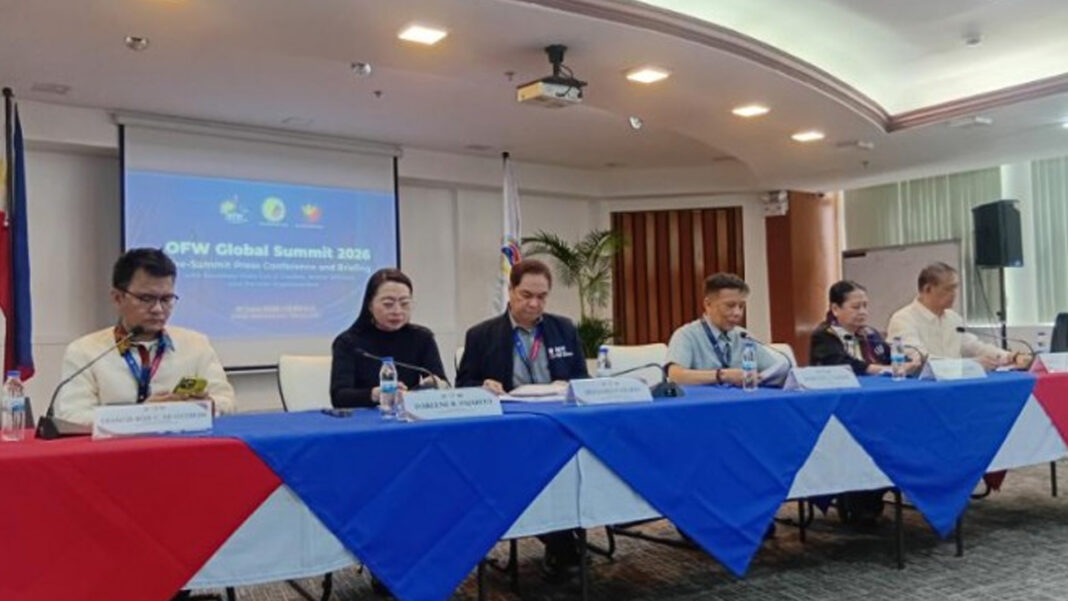
In a press briefing at the DMW main office in Mandaluyong City on Monday, DMW Undersecretary Felicitas Bay and Assistant Secretary Kiko de Guzman said the government’s reintegration efforts have accelerated, particularly for those thousands of Filipino workers affected by conflict in the Middle East.
De Guzman said that since President Ferdinand R. Marcos Jr. led the launch of the National Reintegration Network (NRN) caravan last April, the DMW has visited almost all regions to check on OFWs who returned to the country.
“Nakapagtala na po tayo ng mahigit 4,000 na former OFWs at mahigit 700 na recently repatriated OFWs that have been provided with frontline services and that have been assisted sa kanila pong reintegration needs kabilang na po diyan ang mga kaalaman, kabuhayan, and kalinga programs po natin (We have already recorded more than 4,000 former OFWs and over 700 recently repatriated OFWs who have been provided with frontline services and assisted with their reintegration needs, including knowledge, livelihood and care programs),” he said.
The NRN, led by the DMW, is a unified inter-agency program created by the Philippine government to provide comprehensive, full-cycle support to returning OFWs.
Through the initiative, the DMW, together with 15 other agencies, ensures returning workers receive immediate livelihood, employment and psychosocial assistance rather than returning to uncertainty.
The DMW, through the NRN, also conducts caravans across regions to connect returning workers with government services, employment assistance, financial support programs and training opportunities.
Bay said over 2,000 returning OFWs have already shown interest in availing services and programs.
“Doon sa ating livelihood, ang nag-signify sa amin sa livelihood ay 1,500 more or less. Sa (For the livelihood, around 1,500 signified interest. For) local employment, more than 600. For redeployment, it’s 1,300 more or less,” she said.
She said there are repatriated OFWs who intend to go back to the country where they were working, also because their employers have not canceled their contracts, and they are just waiting for the situation to normalize.
Bay said some have also decided to look for another job in other countries, through government-to-government programs.
“Banggitin ko lang siguro noong (Let me also mention, in) 2023 and 2024, I guess you’re all aware of the Israel-Hamas conflict. So in that conflict, some of the repatriates from Israel, they applied with our government-to-government Placement Bureau for Croatia, 17 hotel workers and some caregivers,” she said.
She cited the caregiver who made a career shift by enrolling in TESDA using the voucher given to her upon her arrival in the country
“So, there’s life after any conflict or hostility. There’s life after repatriation,” Bay said.
Migrant Workers Secretary Hans Leo Cacdac said skills development has become a major focus of reintegration efforts, including expanded training programs in caregiving and emergency health services.
De Guzman, meanwhile, added that training courses in artificial intelligence are also being offered now.
“Expanded program po ito, i-offer sa iba’t ibang regions sa Pilipinas para sa ating mga OFWs (This is an expanded program that we will offer to our OFWs from different regions nationwide) because we believe our OFWs need to be future-ready,” De Guzman said.
The DMW is also coordinating with licensed recruitment agencies and employers to open new pathways for displaced workers.
For the Philippine Independence Day celebration on June 12, the DMW expects around 10 to 12 participating agencies to join a job fair offering more than 4,000 vacancies across Asia Pacific, Europe and the Americas.
DMW Undersecretary Darlene Pajarito said that apart from overseas redeployment, reintegration efforts are increasingly focused on helping workers find opportunities within the country.
“One example, our regional office in Region 9, they were able to help our teachers, 142 teachers who were previously working abroad on a low-level skills work, but now they are employed as licensed teachers in Region 9,” she said.
“So sometimes it’s just closing the gap, within our country, there are opportunities, it’s just that there’s a gap in the connection. So as much as possible, as part of our integration strategy is to close that gap as well and help them find work in our home country,” she added.
Pajarito said the broader objective is to create a full-cycle support system that does not end once workers return home. (PNA)