
ENEOS Holdings Inc. agreed on May 14, 2026, to acquire Chevron Corporation’s entire downstream fuels and lubricants business across Southeast Asia and Australia for $2.17 billion, marking Japan’s largest single energy acquisition in the region and the Japanese refiner’s first overseas refinery stake. The deal transfers the Caltex brand network, more than 1,000 retail stations across multiple markets, and a 50% stake in Singapore’s largest active oil refinery to a company that has until now operated entirely within Japan.
Key Facts At A Glance
- Transaction value: USD 2.17 billion (approximately JPY 336 billion or RM 8.53 billion), to be paid entirely in cash from existing reserves
- Assets acquired: 100% of Chevron’s downstream fuels and lubricants marketing businesses in Singapore, Malaysia, the Philippines, Vietnam, and Indonesia, plus Chevron’s 50% non-operated interest in Singapore Refining Company (SRC)
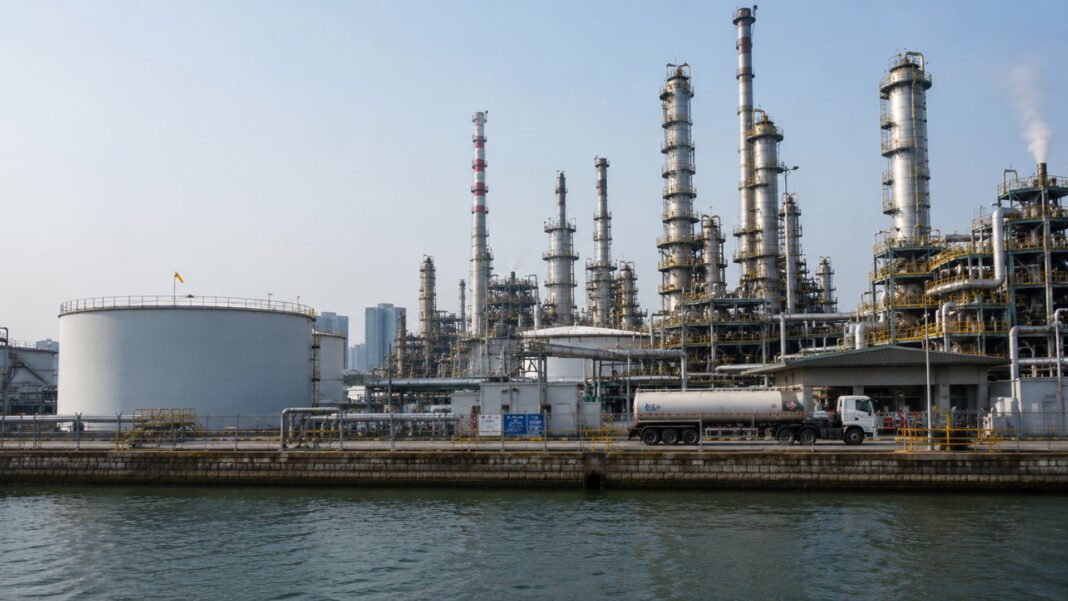
- SRC is located on Jurong Island and processes approximately 290,000 barrels per day of crude oil; the remaining 50% is held by Singapore Petroleum Company, a PetroChina subsidiary
- Transaction vehicle: a special purpose vehicle to be established in Singapore by ENEOS Holdings
- Completion expected: calendar year 2027, subject to regulatory approvals in each market
- The Caltex brand will be retained by ENEOS post-completion; Malaysia alone has over 450 Caltex stations, while the Philippines has nearly 600
- ENEOS CFO Soichiro Tanaka confirmed the acquisition will be funded from existing cash reserves; Morgan Stanley advised Chevron on the sale
- ENEOS FY2025 operating profit reached JPY 466.6 billion, exceeding forecasts
A Strategic Pivot Driven By Domestic Decline
ENEOS Holdings (TSE: 5020) is Japan’s largest oil refiner, operating nine refining complexes across the country. Despite its scale, the company faces a structural problem: petroleum demand in Japan is projected to decline over the medium to long term as the country’s population contracts, fuel efficiency improves, and electrification of transportation accelerates. That domestic reality has made overseas expansion an operational necessity rather than a strategic option.
The Chevron transaction addresses that constraint directly. ENEOS CEO Miyata Tomohide described the deal as a step toward building a business platform connecting Japan with Southeast Asia and Oceania, adding that the company intends to raise its overseas revenue share from just under 20% of total sales to more than 50% by fiscal 2030. The company explicitly said this acquisition alone will not be sufficient to reach that target and indicated further overseas acquisitions are already being evaluated.
What ENEOS Is Buying
The transaction is structured through share purchase agreements signed with multiple indirect subsidiaries of Chevron Corporation. Through a Singapore-incorporated special purpose vehicle, ENEOS will take full ownership of Chevron Singapore Pte. Ltd., which holds the SRC refinery stake and Chevron Lubricants Vietnam Ltd.; Chevron Malaysia Limited; Chevron Philippines Inc.; Chevron Australia Downstream Holdings Pty Ltd.; and PT Chevron Oil Products Indonesia.
The centerpiece of the package is the SRC stake. Singapore Refining Company, located on Jurong Island, is one of Singapore’s two major operating refineries following Shell’s sale of its Bukom and Jurong Island refining and petrochemical complex to a joint venture between PT Chandra Asri Pacific and Glencore in 2024. SRC produces a range of refined products including bunker fuels, which are critical to Singapore’s position as one of the world’s largest bunkering ports. Beyond the refinery, the deal includes Chevron’s Penjuru terminal and lubricants facility in Singapore, which holds approximately 400,000 cubic meters of storage capacity, equivalent to roughly 2.5 million barrels of oil.
Control of that terminal is significant. Singapore functions as one of the largest oil storage, blending, and trading hubs in the world, and ownership of terminal infrastructure gives ENEOS direct access to paper-market trading and derivatives activity. The company has already been expanding its trading team in Singapore to handle such instruments. Sushant Gupta, Wood Mackenzie’s Asia Pacific refining and oils research director, said the acquisition is an important strategic move for ENEOS given the saturation of its domestic Japanese market, and noted that the terminal and lubricants businesses would serve as additional sweeteners beyond the refinery stake itself.
Chevron’s Exit Strategy
For Chevron Corporation (NYSE: CVX), the sale is the latest in a series of downstream divestments across Asia as the American major concentrates capital on upstream production and higher-return projects. Earlier this year, Chevron sold its Hong Kong retail fuel business to Thailand’s Bangchak Corp. for $270 million. Exxon Mobil Corp. has also offloaded Southeast Asian downstream assets in recent years. Chevron’s downstream president Andy Walz framed the ENEOS transaction as reflecting the company’s portfolio discipline, noting that the Caltex brand would continue under ENEOS ownership and that the transition would be orderly. The Caltex brand traces its origins to the California Texas Oil Company and has operated across Asia-Pacific markets for over 90 years.
Market-By-Market Reach
The operational footprint being transferred is substantial. In Malaysia, ENEOS acquires over 450 Caltex-branded petrol stations operated through Chevron Malaysia Limited. In the Philippines, where Chevron entered in 1917, the company operates nearly 600 Caltex service stations and 20 supply facilities. In Vietnam, the transfer includes Chevron Lubricants Vietnam Ltd. In Indonesia, PT Chevron Oil Products Indonesia passes to ENEOS. The Singapore assets include both the SRC stake and the Penjuru terminal complex. All Caltex branding is expected to remain unchanged following completion of the transaction.