

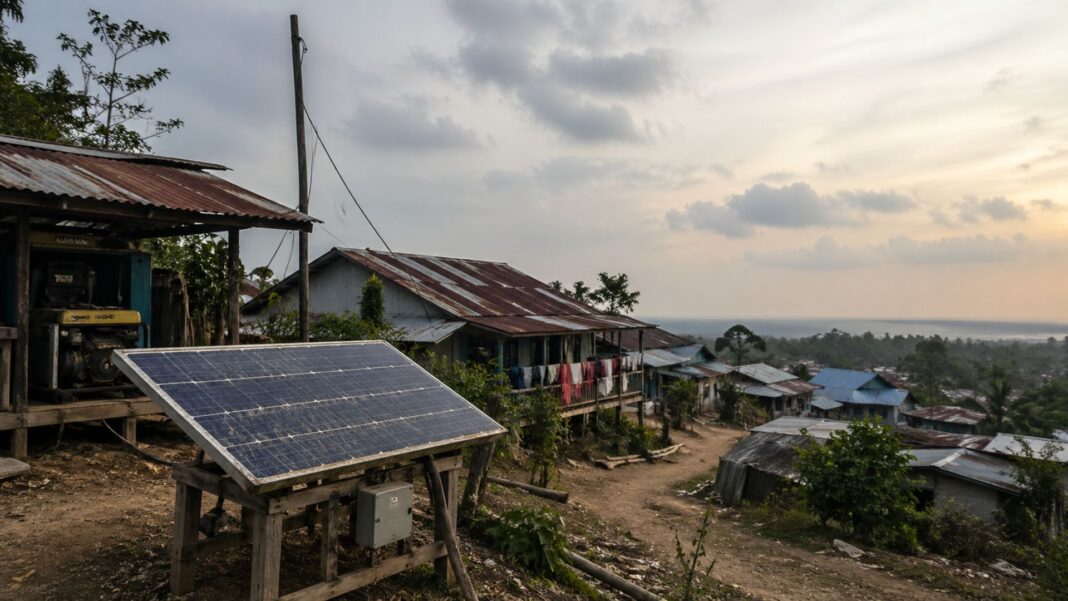

A joint report by the Center of Economic and Law Studies and Greenpeace Indonesia documents that the number of villages reporting household solar power use fell from 4,176 to 3,076 between 2021 and 2024, a decline of 26.4 percent, even as the Hormuz crisis accelerates the country’s coal dependency and draws fresh scrutiny to the structural barriers blocking Indonesia’s energy transition.
Key Facts At A Glance
- Villages and subdistricts reporting household solar use: 4,176 in 2021, falling to 3,076 in 2024, a 26.4% reduction
- Villages using solar-powered street lighting rose over the same period: from 24,766 in 2021 to 30,476 in 2024, up 20.1%
- Indonesia has 84,291 villages as of 2025; approximately 1.4 million people remain without any electricity access
- Report title: Village Energy Transition Readiness Index, produced jointly by the Center of Economic and Law Studies (Celios) and Greenpeace Indonesia
- Data source: Indonesia’s national village census (PODES), surveys conducted in 2021 and 2024
- Primary causes identified: high installation costs, minimal household-level incentives, and fossil fuel subsidy dominance
- Indonesia’s 2026 budget allocated IDR 381.3 trillion for fuel subsidies based on an assumed crude price of USD 70 per barrel; crude is trading above USD 100 per barrel as of late April 2026
- Coal’s share of Indonesia’s power generation: approximately 68%; Indonesia’s renewable energy share reached only 16% by mid-2025, against a 23% target originally set for 2025 and now deferred to 2030
The Finding And Its Context
The Village Energy Transition Readiness Index, published by Celios and Greenpeace in April 2026, measures village readiness across three dimensions: clean energy initiatives, economic resilience, and village governance capacity. It draws on Indonesia’s PODES village census data for 2021 and 2024, spanning the country’s more than 84,000 administrative units.
The headline finding is a documented reversal. Despite global photovoltaic hardware costs continuing to fall throughout the period, the number of communities where solar energy is present in household use declined by over a quarter. The divergence within the solar category itself sharpens the analysis. Solar street lighting, which relies on public budget allocations rather than household capital, expanded by 20.1 percent over the same three years, reaching 30,476 communities. The contrast isolates the mechanism: where public spending backstops installation, deployment grows. Where households must bear upfront costs with little incentive support, adoption retreats.
“Village street lighting has increased, while household use has declined due to high initial costs, minimal incentives, and the dominance of fossil fuel subsidies,” the report states. Celios researcher Wahyudi Askar framed the implications directly: “Previously, many villages had clean energy initiatives, including solar power plants, micro-hydropower plants, and others, but the number of such initiatives has actually gone down. When global oil prices are today rising and the energy transition in Indonesia is simultaneously moving slowly, we will experience serious consequences.”
The Subsidy Architecture Problem
Indonesia’s fossil fuel subsidy structure is the report’s central explanatory variable. In 2024, the International Institute for Sustainable Development estimated that fossil fuels accounted for 88.9 percent of total energy support in Indonesia, with oil, gas, coal, and the vast majority of electricity subsidies captured under that figure. Three individual subsidy programs each individually exceeded IDR 100 trillion per year: compensation for below-market electricity pricing, the 3-kilogram LPG cylinder subsidy, and fuel compensation payments to PT Perusahaan Listrik Negara.
By artificially compressing the retail price of kerosene, diesel, and grid electricity for rural consumers, the subsidy architecture removes the cost differential that would make solar and micro-hydro installations financially attractive at the household level. A rural household in eastern Indonesia, served by a diesel minigrids subsidized through the missionary electrification fund, faces a retail electricity price that does not reflect true generation cost. Against that benchmark, a solar home system requiring significant upfront capital, with no comparable incentive mechanism, is not economically competitive, regardless of the panel price on international markets.
This structural dynamic has been documented across multiple research institutions. The Institute for Energy Economics and Financial Analysis noted that government subsidies to PLN increased by 24 percent to USD 11 billion in 2024, representing approximately 5 percent of the national budget. IEEFA also recorded that coal power costs in Indonesia rose 48 percent between 2020 and 2024 due to aging plants and rising operational costs, yet those cost increases were absorbed by the subsidy system rather than passed through to consumers, insulating demand from the price signals that would otherwise accelerate the transition.
Regional Inequality And Maintenance Gaps
The Celios-Greenpeace index also documents pronounced geographic inequality in transition readiness. Java and wealthier western regions show stronger village governance scores and higher clean energy initiative counts. Eastern Indonesia, where solar irradiance is highest and off-grid communities are most numerous, lags on both measures.
Anecdotal evidence cited by the report points to a recurring failure mode in coastal and island communities: basic photovoltaic systems, once installed, often do not survive component failures. Salt corrosion in coastal environments damages panels, inverters, and battery systems. Spare parts are difficult to source and expensive to ship to remote locations. Without a maintenance fund or service network, a working solar installation can become non-functional within a few years of commissioning, effectively erasing the investment. This lifecycle gap helps explain why the village count declined even in communities where installations had previously existed.
Indonesia’s decentralization framework compounds the problem. The 2001 decentralization law and its 2014 amendment gave village heads authority over local education, infrastructure, health, and sanitation, but without clear guidance or dedicated budget allocations for energy transition projects. Village development funds flow through local priorities. In the absence of a mandated energy transition line item, solar installations compete against road repairs, school maintenance, and health post equipment, and frequently lose.
The Hormuz Crisis As Complicating Factor
The report’s release coincides with Indonesia’s most acute fuel security crisis since becoming a net oil importer in 2003. The Strait of Hormuz disruption, ongoing since late February 2026, has placed the country’s subsidy commitments under severe fiscal strain. Indonesia’s 2026 national budget calculated subsidy costs on a crude oil assumption of approximately USD 70 per barrel. With Dubai crude trading at approximately USD 100 to 102 per barrel as of late April, the actual subsidy burden exceeds budget projections. Each USD 1 increase in the oil price widens the national fiscal deficit by approximately USD 400 million, according to analysis cited by Indonesia Business Post. The cumulative strain represents a potential USD 3 billion budget pressure.
The government’s emergency response has prioritized fossil fuel availability over renewable expansion. Subsidized fuel prices for Pertalite and Bio Solar have been frozen through the end of 2026. Rationing was introduced on March 31, capping subsidized fuel purchases for private vehicles at 50 liters per day through the MyPertamina system. Coordinating Economic Minister Airlangga Hartarto separately confirmed that President Prabowo Subianto instructed officials to raise coal production quotas and revise miners’ Work Plans and Budgets, with quota revisions expected in the second half of 2026. Newcastle coal futures rose approximately 16 percent following the Iran war’s onset, reaching USD 135 per tonne.
Celios researchers Bhima Yudhistira Adhinegara and Muhammad Zulfikar Rakhmat argued in a published commentary that the crisis should serve as a catalyst rather than a setback: “A global oil crisis should not be treated only as a short-term emergency. It should also be treated as a catalyst for a faster shift toward cleaner, more resilient energy systems.” Rystad Energy analyst Vicky Janita noted that Indonesia’s prioritization of domestic coal consumption over exports was simultaneously tightening supply availability for other Asian importers, suggesting the country’s crisis response carries regional market consequences beyond its own borders.
Civil society groups have called for windfall taxes on fossil fuel companies benefiting from elevated prices, arguing the revenue should fund a people-centered energy transition. Walhi campaign coordinator Uli Arta Siagian stated: “A just solution is not to burden the public further, but to impose taxes on major emitters as part of climate justice and to finance a people-centered energy transition.”
Policy Recommendations
The Celios and Greenpeace Village Energy Transition Readiness Index calls on the Indonesian government to redirect a portion of fossil fuel subsidies toward renewable energy deployment at the village level, expand micro-hydro and solar programs in eastern Indonesia, establish dedicated maintenance funds to sustain existing solar assets, and grant village governments a more formalized role in energy transition planning. Researchers argue that the technology and human resources required for acceleration are already available, and that consistent policy direction is the missing variable.
Indonesia’s mining and energy ministry official Eniya Listiani Dewi confirmed that approximately 1.4 million Indonesians remain without electricity access, underscoring that baseline electrification gaps persist alongside the documented reversal in household solar adoption.