

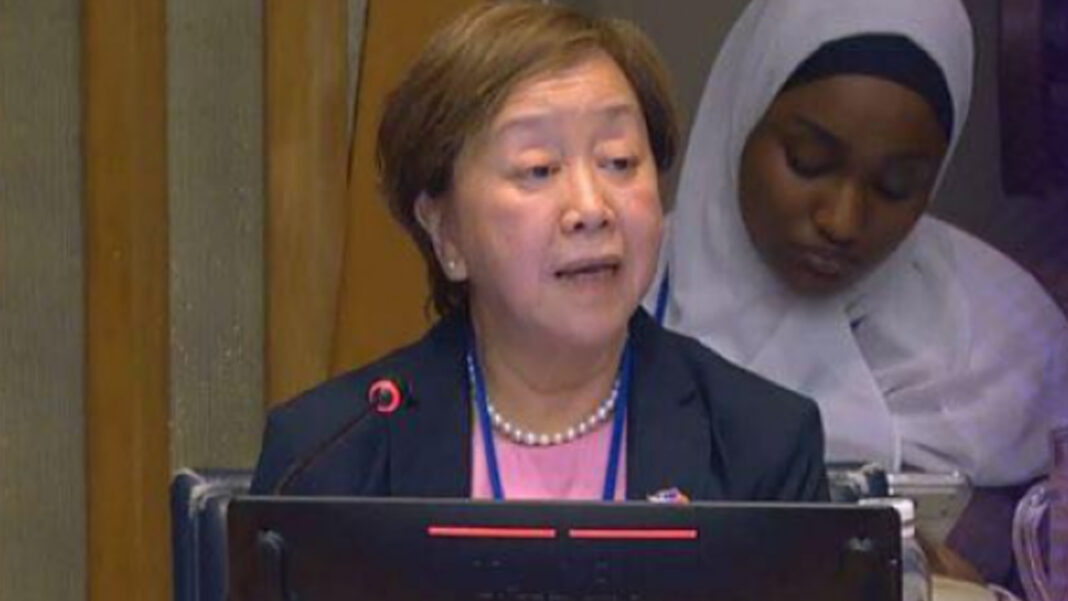

The Philippines has called for stronger international cooperation as it pushes for data-driven governance and local programs to ensure that technology and research support equitable and sustainable development during the 59th session of the United Nations Commission on Population and Development at the United Nations Headquarters, held from April 13 to 17 in New York.
In a press release Monday, Commission on Population and Development (CPD) Undersecretary Lisa Grace Bersales noted that developing countries need greater support in addressing structural gaps that limit access to technology.
Bersales called on the international community to assist developing countries in three areas, particularly in addressing the digital divide, strengthening institutional capacities, and ensuring equal access to new technology.
“We therefore call for strengthened international cooperation to support developing countries in closing digital divides, building institutional capacity, and ensuring equitable access to technological innovations,” she said.
During the session themed “Population, technology and research in the context of sustainable development,” Bersales discussed how innovation can be leveraged while upholding human rights and promoting inclusivity.
The CPD highlighted its push for data-driven governance through digital transformation of statistical and civil registration systems, including the use of digital census and survey technologies, geospatial integration, and interoperability across government data platforms.
It also cited the country’s enactment of the E-Governance Act of 2025, which institutionalizes digitalization in public service delivery and strengthens evidence-based policymaking.
Bersales said the integration of the Community-Based Monitoring System in the 2024 Census of Population is expected to allow faster generation of disaggregated data for local planning.
On health in the life course, specifically sexual and reproductive health and rights (SRHR), the Philippines reported expanding digital tools such as telemedicine, mobile health applications, and data-driven decision-making systems to improve access to services, particularly in geographically isolated and disadvantaged areas (GIDAs).
However, the CPD stressed that emerging technologies like artificial intelligence (AI) must be complemented by investments in healthcare systems, workforce development, and digital literacy.
The Philippines also flagged rising adolescent pregnancy cases among girls aged 10 to 14.
The government also acknowledged that unequal access to technology remains a major challenge, prompting continued investments in digital infrastructure, rural connectivity, and digital skills training, especially for women, youth, and marginalized sectors.
It said that in 2024, over 80 percent of Filipinos owned a mobile phone, while half of all households had internet access at home.
Three out of 10 Filipinos also have e-commerce accounts, a significant increase from 3 percent recorded in 2019.
The CPD said these initiatives align with the National Cybersecurity Plan 2023-2028 of the Department of Information and Communications Technology (DICT), which aims to strengthen trust in digital systems by improving regulation, privacy protection, and cybersecurity.
The agency underscored that technology must remain people-centered, supported by regulatory frameworks that ensure ethical use and safeguard personal data, and cited the proposed National AI Strategy of the Department of Science and Technology (DOST) to guide artificial intelligence development and governance.
The Philippines also highlighted employment gains from digitalization, with the digital platform economy generating 11.3 million jobs in 2024, mostly driven by e-commerce.
The CPD added that the country’s 10-year Trabaho Para sa Bayan Plan 2025-2034 aims to future-proof the workforce through digital skills development, green jobs, and innovation-led industries.
The Philippines is also promoting lifelong learning, digital skills development, and workforce reskilling to adapt to the changing nature of work in the digital age.
Despite progress, the Philippines said challenges such as the digital divide, limited research capacity, and unequal access to online platforms continue to drive inequality.
“Technology is not an end in itself—it is a means to empower people, expand choices, and achieve sustainable and equitable development,” Bersales said.
The Philippines, meanwhile, reiterated its commitment to advancing a rights-based, inclusive, and evidence-driven population and development agenda, where research and technology serve humanity, uphold human dignity, and ensure that no one is left behind. (PNA)