

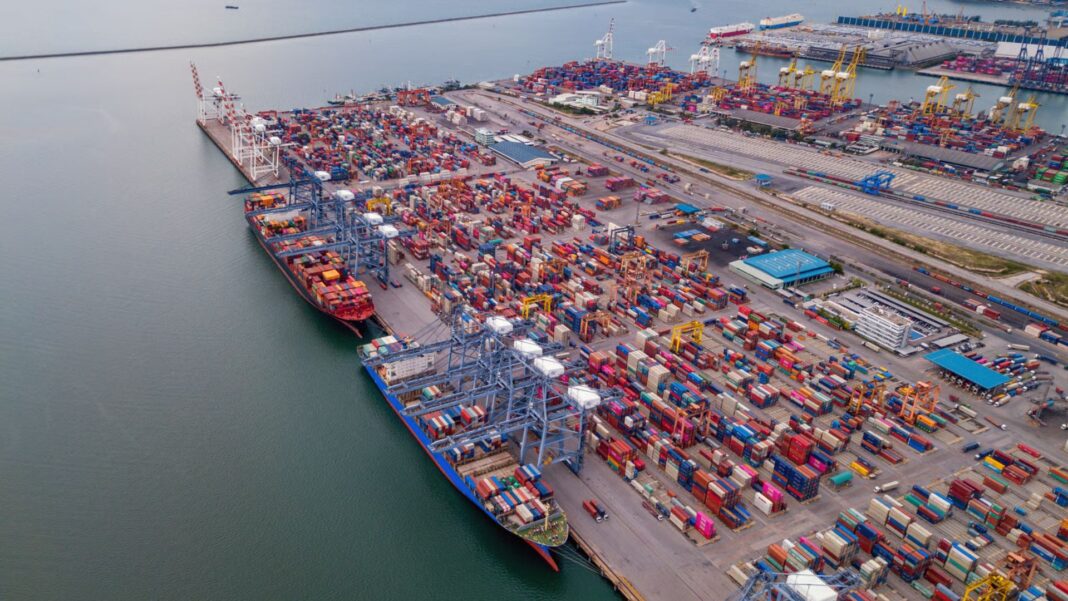

Cambodia’s Sihanoukville Autonomous Port is advancing a phased expansion plan targeting a seven-fold increase in freight handling capacity by 2050, with Japan serving as the principal financing partner. The port’s growing strategic importance has been sharpened by the sustained closure of Cambodia’s land borders with Thailand following armed clashes in 2025, forcing goods that previously moved overland to shift to maritime routes through Sihanoukville.
Key Facts At A Glance
- Seven-fold expansion of Sihanoukville Autonomous Port freight capacity targeted by 2050
- Three-phase expansion plan totalling approximately USD 973 million, with roughly USD 700 million in Japanese concessional loans
- Phase 1: USD 243 million, 120.2-km double-track terminal at 14.5 metres depth, capacity of 1.25 million TEUs annually; construction by Japanese firm TOA Corporation
- Phase 2 (2025–2028): Enables 120,000-tonne vessels, raising capacity to over 1.8 million TEUs annually
- Phase 3 (2026–2029): Enables 160,000-tonne vessels, 15,000 TEU capacity, reaching 2.5 million TEUs annually
- Land border closures with Thailand cut bilateral trade by approximately 15% in 2025, to around USD 3.6 billion, accelerating the port’s strategic relevance
- Japan International Cooperation Agency (JICA) and the Ministry of Public Works and Transport are co-developing a master plan to position Sihanoukville as a regional logistics hub
Cambodia Moves To Anchor Its Own Logistics Future
Cambodia is pursuing one of the most significant port infrastructure programmes in Southeast Asian history, a three-phase overhaul of Sihanoukville Autonomous Port that would transform the country’s only deep-water seaport from a regional footnote into one of ASEAN’s primary maritime gateways. Nikkei Asia reported on April 14, 2026, that Phnom Penh is advancing a proposal calling for a seven-fold increase in freight handling capacity by 2050, with Japan serving as the anchor financing partner.
The timing of the announcement is not incidental. Cambodia’s traditional reliance on overland trade through Thailand collapsed in 2025 following a series of armed border clashes that led to the closure of all major land crossings. Thai-Cambodian bilateral trade declined approximately 15% in 2025 to around USD 3.6 billion as overland routes shut down and companies scrambled to redirect shipments by sea. That structural shock has made maritime capacity no longer a supplementary concern but a matter of national economic continuity.
A Port Built On Japanese Capital
Japan has been embedded in Sihanoukville Port’s development since 1999, when the Japan International Cooperation Agency first funded the port’s rehabilitation following decades of conflict-era neglect. The current expansion programme, the most ambitious in the port’s history, is structured in three phases with a combined investment of approximately USD 973 million. Japan is financing around USD 700 million through concessional ODA loans, with the remainder contributed by the Royal Government of Cambodia and port-generated revenue.
Phase 1, valued at approximately USD 243 million, is under construction by Japan’s TOA Corporation, with technical supervision provided by Nippon Koei and Oriental Consultants Global. The new deep-water container terminal is being built to 350 metres in length and 14.5 metres depth, capable of accommodating vessels of 60,000 tonnes or 4,000 TEU capacity. Upon completion, Phase 1 will raise the port’s annual throughput capacity to approximately 1.25 million TEUs. Phase 1 construction had reached approximately 50–60% completion as of early 2026, with commissioning now expected in 2027.
Phase 2, running from 2025 to 2028 and projected to cost part of the remaining USD 698 million alongside Phase 3, will enable vessels of up to 120,000 tonnes and raise annual capacity to over 1.8 million TEUs. Phase 3, scheduled from 2026 to 2029, will allow container vessels of up to 160,000 tonnes and 15,000 TEU capacity, bringing total throughput to approximately 2.5 million TEUs per year.
The Long-Term Master Plan
Beyond the three phases of immediate construction, Japan and Cambodia are co-developing a longer-horizon master plan for Sihanoukville that envisions the port as a full regional logistics hub. The Ministry of Public Works and Transport and JICA held a joint planning session in January 2026 with technical consultants from the Overseas Coastal Area Development Institute of Japan to define priority actions. The master plan is targeting the ability to receive container ships carrying up to 15,000 TEUs, positioning the port to compete directly with mid-tier regional hubs.
The geopolitical logic behind Japan’s deep commitment to Sihanoukville has multiple layers. For decades, Japanese manufacturers have operated regional production networks spanning Thailand and Cambodia under what industry analysts have described as a “Thailand+1” strategy, routing labour-intensive manufacturing to lower-cost Cambodian facilities while retaining higher-value processes in Thailand. The border crisis has disrupted that architecture directly, with components no longer reaching Cambodian factories and production lines stalling. Rebuilding logistics resilience is as important to the approximately 500 Japanese companies operating in Cambodia as it is to the Cambodian government.
Border Closure As Structural Catalyst
The border situation has shifted the port’s development from a medium-term aspiration to an immediate operational necessity. When Thai-Cambodian land crossings shut in mid-2025, recorded border trade fell by approximately 97% in a single month. Companies that previously moved goods in 500-kilometre truck runs from Sa Kaeo to Sisophon found themselves facing routes three times as long, with transport costs rising by 15–20%. South Korean carrier HMM issued a global advisory warning customers against routing Cambodia-bound cargo via Thailand. Air charter operations surged to fill the gap, with around 100 charter flights moving more than 5,000 tonnes of cargo out of Bangkok airports.
Sihanoukville port cargo throughput rose sharply throughout 2025 as a direct result. The port handled approximately 800,000 TEUs in 2023 and the trajectory upward has continued. Ambassador of Japan to Cambodia Ueno Atsushi noted publicly in early 2026 that the port has played an increasingly critical role as companies shift to maritime logistics in response to the border disruption.
Cambodia’s government has signalled that a return to the pre-crisis status quo is not anticipated. Senate President Hun Sen stated publicly that Cambodia would not reopen the border “even if it remains closed for a hundred years,” a declaration that positions Sihanoukville’s development not as a contingency measure but as a long-term strategic priority.
Competitive Implications For The Region
The expansion, if executed on schedule, will mark a significant shift in ASEAN’s port hierarchy. Sihanoukville currently handles a fraction of throughput compared to regional leaders. Singapore manages approximately 37 million TEUs annually, while Thailand, Malaysia, and Indonesia all operate ports exceeding 7 million TEUs. A Sihanoukville capable of 2.5 million TEUs by 2029 would not compete at that scale but would eliminate Cambodia’s dependence on third-country transshipment, including through Singapore and Vietnamese ports such as Cai Mep, for large vessel calls.
For investors in Cambodian manufacturing, export logistics, and industrial real estate, the port’s expansion reduces one of the country’s most persistent cost disadvantages. For Japan, the investment deepens bilateral ties at a moment when Tokyo is extending its strategic and economic footprint across mainland Southeast Asia.