

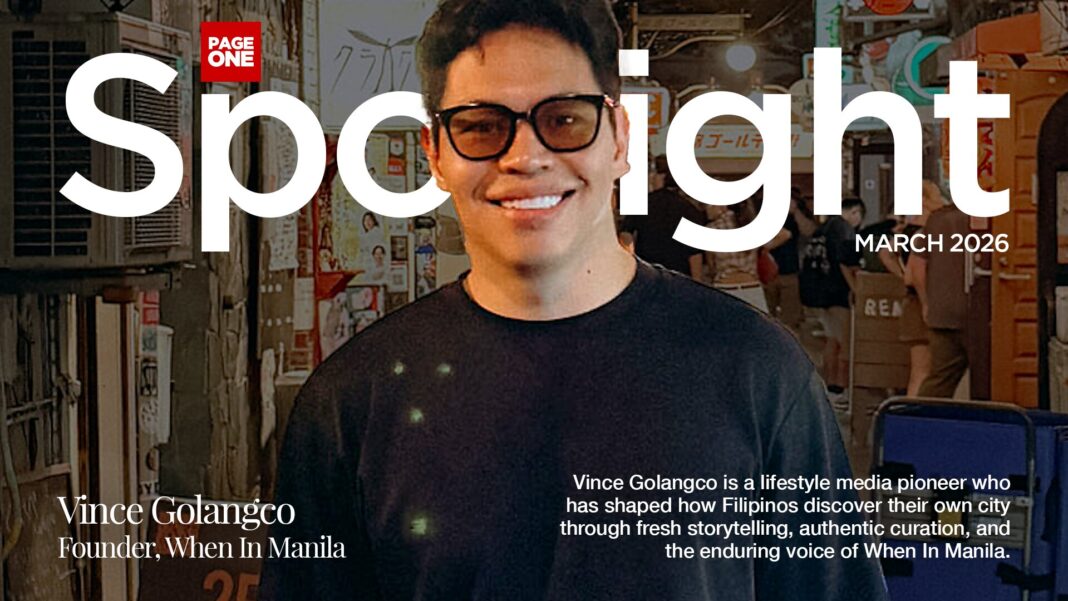

Fifteen years in, the question is no longer how When In Manila grows. It is what it becomes when the moment that built it begins to shift.
At the center of that question is Vince Golangco, who has spent more than a decade building a platform that now exists far beyond its original blog form. What started as a personal project has evolved into something shaped by a community, sustained by habit, and tested by time.
For Golangco, the future of When In Manila is not tied to his presence alone.
“The measure of a real brand is whether it can stand without the founder,” he says.
It is a goal still in progress. He admits the platform is not fully there yet, but the direction is clear. Over time, the identity of When In Manila has expanded beyond a single voice. It now belongs as much to its readers, contributors, and community as it does to the person who started it. That shift, from ownership to shared space, is what Golangco sees as necessary for longevity.
Reaching that point has required constant reinvention.
When In Manila did not grow in a straight line. It adapted, sometimes just in time. Golangco describes the process almost as a cycle. Every few years, the platform had to change how it created and delivered content. From blog to social. From social to video. From long-form articles to short-form storytelling.
“Every two to three years, honestly,” he says.
Not every transition was smooth. There was a period when the platform struggled to keep up with the shift toward mobile-first consumption. The delay nearly cost it relevance.
“We moved too slowly and nearly became irrelevant,” Golangco admits.
That moment left a lasting impression. It became a reminder that staying still is not an option in a space defined by constant change. Since then, comfort has not been part of the strategy. The platform continues to adjust, not just to survive trends, but to understand them before they pass.
Still, for all the changes in format and platform, there is something When In Manila carries that cannot be replicated overnight.
“Fifteen years of trust and context,” Golangco says.
New platforms can mirror the look, the tone, even the pacing of content. But time is harder to imitate. Years of consistent publishing, audience interaction, and shared experiences build something less visible but more durable. Trust accumulates slowly, and once earned, it becomes the foundation everything else rests on.
That foundation is what allows When In Manila to continue evolving without losing its identity.
When asked what legacy looks like, Golangco does not point to scale or expansion. Instead, he returns to something more personal. He hopes the platform has helped people experience the country in ways they might not have otherwise.
“That we genuinely helped people discover and love Manila, the Philippines, and Filipinos,” he says.
The impact he describes is not abstract. It lives in small, everyday decisions. A restaurant someone tried for the first time. A date planned through a recommendation. A trip that started with a single article. Moments that feel personal, even if they were quietly influenced by something read online.
He also points to the role the platform has played for creators. Over the years, When In Manila has given Filipino writers and contributors a space to publish, to share, and to be seen at a time when those opportunities were not always easy to find.
“That’s enough,” Golangco says.
In a digital landscape that constantly resets itself, legacy is often difficult to define. Trends move quickly. Platforms rise and fall. Attention shifts.
But When In Manila was never built on speed alone. It was built on showing up, repeatedly, until the audience learned to trust what it found there.
What comes next is not about holding on to what worked before, but about allowing the platform to continue without needing to look back.
Because if it succeeds, When In Manila will no longer be defined by when it started, or even by who started it, but by the people who continue to find something of their own within it.