
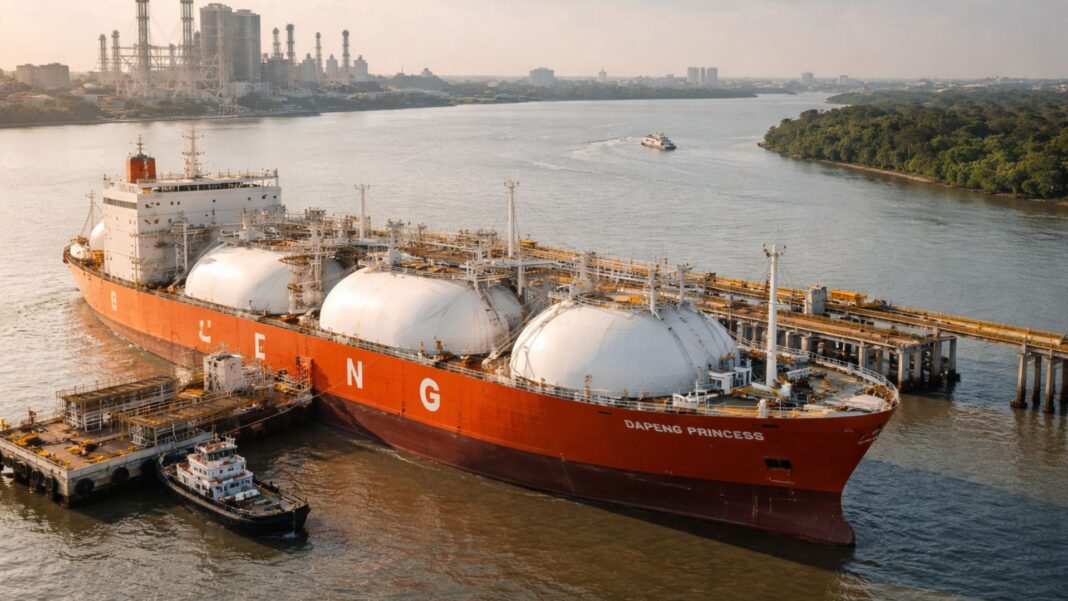

The MT Dapeng Princess completed its fifth delivery of liquefied natural gas to Thilawa Port in Yangon on or around March 22, 2026, bringing 33,800 tonnes of LNG into a national grid system running well below demand. The delivery sustains power output from two CNTIC VPower-operated plants that supply 24-hour electricity to Yangon’s industrial zones, and represents the most visible forward movement in Myanmar’s effort to rebuild grid capacity through imported fuel after a four-year LNG hiatus.
Key Facts At A Glance
- The MT Dapeng Princess delivered 33,800 tonnes of LNG to Thilawa Port on its fifth call since Myanmar resumed imports in late 2025
- LNG-to-power plants in Yangon are currently generating 500 MW, serving industrial zones including Thilawa SEZ and Myaungtaga Industrial Zone
- The plants involved are the 300 MW Thaketa plant and the 200 MW Thanlyin plant, both operated by a consortium including CNTIC VPower and local partner Everest Energy Solution
- A sixth delivery is scheduled for early April 2026
- Myanmar’s total electricity demand stands at approximately 4,664 MW; current generation is estimated at around 3,600 MW
- Myanmar authorities separately issued warnings against diesel hoarding on March 22 amid broader regional fuel pressures
- Kpler estimates Myanmar will import approximately 0.4 million tonnes of LNG in 2026 to sustain LNG-to-power operations
Myanmar’s LNG-Fuelled Power Restart At Thilawa
The MT Dapeng Princess is not a standard LNG tanker. It is a specialized shallow-draft carrier purpose-built for Myanmar’s constrained logistics environment. The Yangon River imposes a maximum draft of around nine metres, ruling out conventional large-scale LNG vessels. The Dapeng Princess shuttles fuel from a floating storage unit (FSU) moored near Thilawa to the onshore regasification facility that feeds the Thaketa and Thanlyin power plants. That infrastructure was originally installed by the CNTIC VPower consortium, which built and operated Myanmar’s first LNG-to-power system beginning in 2020 before the program collapsed in 2021 following the military coup, foreign exchange shortfalls, and the departure of the FSU in early 2023.
The restart, which began with a first delivery in November 2025 sourced from Malaysia’s Bintulu LNG terminal, has moved from an initial 150 MW output in December to the current 500 MW operating level. The Global New Light of Myanmar, the state-run daily, confirmed on March 22 that the fifth delivery was complete and that the plants are providing uninterrupted power to Yangon’s industrial zones, including Thilawa SEZ, the Myaungtaga Industrial Zone for iron processing, and key government facilities.
The Context Of Chronic Generation Deficit
The significance of 500 MW becomes clearer against Myanmar’s generation history. In early 2025, total national output fell below 2,000 MW on multiple days against a daily demand of approximately 4,400 to 4,664 MW. The Ministry of Electricity and Energy acknowledged in January 2025 that generation was meeting only around 50 to 55 percent of national demand. Yangon, which accounts for close to half of national electricity consumption, was receiving power for eight hours a day or less, with residents in some townships reporting as few as two to three hours of actual supply.
The causes are layered. Domestic gas production has been in structural decline since the 2021 coup drove out multinational operators, and key fields including Yadana and Zawtika are on a downward trajectory. The Shwe field in western Rakhine State was projected to begin declining in 2026. Grid infrastructure has sustained over 200 recorded attacks since the coup. Hydropower reservoirs are seasonally constrained, with the dry season from approximately January to May historically producing sharp drops in hydro output. The result is a system in which any addition of firm baseload power, regardless of the political context under which it is delivered, carries direct consequence for industrial operations, employment, and basic services in Yangon.
Industrial Zones As The Priority Load
The current LNG-to-power output is directed entirely at industrial consumers rather than the broader residential grid. Thilawa SEZ, Myanmar’s largest special economic zone, hosts manufacturing operations across garments, food processing, construction materials, and light industry. The Myaungtaga Industrial Zone in Yangon handles iron and metal processing. These facilities require continuous power supply to operate machinery and maintain export commitments. The 24-hour supply from the LNG plants insulates these zones from the rotating blackout schedules affecting the rest of Yangon.
This allocation reflects a deliberate prioritization. The authorities have consistently directed available generation toward Yangon at the expense of Mandalay and other regions, and within Yangon toward industrial zones and government facilities over residential areas. The 500 MW now flowing from the Thaketa and Thanlyin plants, while not new capacity built since the restart, is restored capacity from assets that had been idle for approximately four years.
The delivery timing also coincides with regional pressure on diesel supplies arising from the Strait of Hormuz disruption. Myanmar authorities issued a separate warning on March 22 urging fuel distributors not to hoard diesel, which serves as backup generation fuel for households, businesses, and off-grid facilities across the country. LNG supply for grid-connected industrial power and diesel availability for distributed backup generation represent two distinct but related energy security threads that are both under strain simultaneously during the current crisis.
Next Delivery And Outlook
The Dapeng Princess is scheduled for a sixth call at Thilawa in early April. Kpler, the commodity data firm, has projected total LNG imports for Myanmar at approximately 0.4 million tonnes in 2026 to sustain the LNG-to-power operations. Whether the ramp-up can be maintained through the dry season, when hydropower output typically falls and electricity demand from cooling rises, will determine whether the current 500 MW figure holds or faces pressure from competing feedstock priorities across a region where LNG supply chains remain disrupted.
Reporting on this story from primary sources is limited. The Global New Light of Myanmar is state-controlled media, and independent verification of operational figures from Thilawa is not available. No statement from CNTIC VPower or Everest Energy Solution has been confirmed in international reporting for the fifth delivery specifically.