

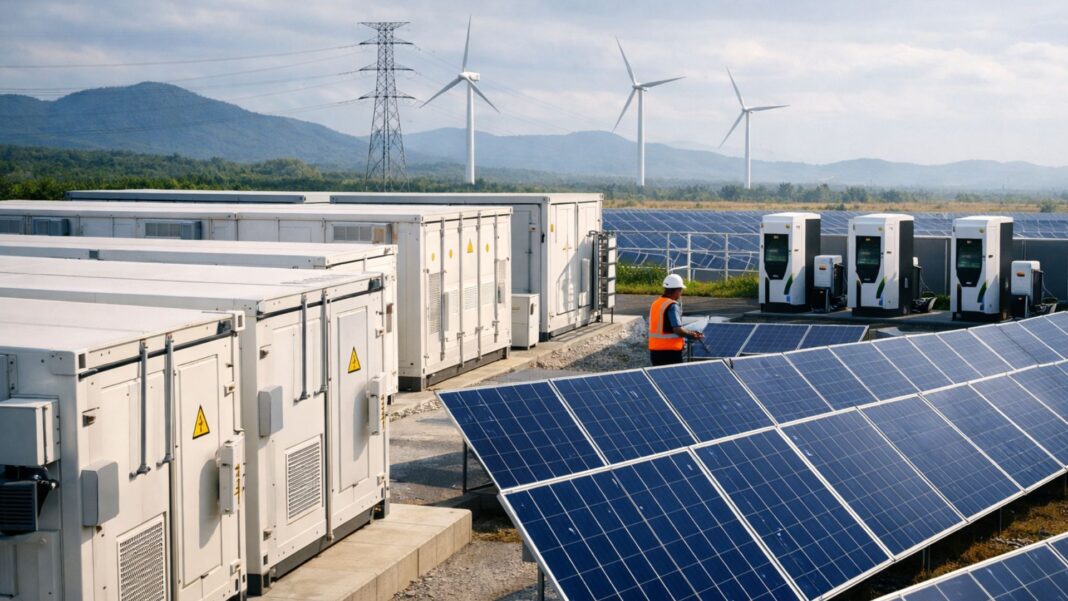

Cape EMS Berhad, a Main Market-listed electronics manufacturing services company in Malaysia, announced on March 16, 2026, the acceleration of its renewable energy platform through its wholly owned subsidiary Cape Renewables Sdn Bhd, marking a structural shift in the group’s business model from traditional contract electronics manufacturing toward clean energy infrastructure.
The expansion forms a core pillar of Cape EMS’s “CEB 2.0” strategic transformation roadmap, which the group has been executing over the past 12 to 24 months, and arrives as the company reports a return to profitability following a sustained loss-making period.
Key Facts At A Glance
- Cape EMS Berhad (Bursa: CEB) announced on March 16, 2026, the expansion of Cape Renewables Sdn Bhd, its wholly owned renewable energy subsidiary, as a core pillar of the CEB 2.0 strategy
- Cape Renewables will deliver integrated solutions combining solar photovoltaic systems, battery energy storage systems (BESS), and smart energy management platforms targeting industrial users
- The expansion leverages a strategic collaboration agreement signed on March 25, 2025, with Aerospace Industrial Development Corporation (AIDC), a Taiwan Stock Exchange-listed aerospace company with the Taiwanese government retaining a 39% stake
- Cape Renewables is developing a nationwide EV charging infrastructure mapping platform aligned with Malaysia’s National Energy Transition Roadmap (NETR)
- Cape EMS returned to profitability in Q2 FY2026 (quarter ended December 31, 2025), reporting a net profit of RM7.04 million against a net loss of RM48.84 million in the same quarter the prior year
- Revenue for Q2 FY2026 was RM89.554 million; gross profit recovered to RM24.24 million from RM0.72 million year-on-year
- Cape EMS carried a market capitalisation of approximately RM298 million at the time of the March 16 announcement
Strategic Pivot Under CEB 2.0
Cape EMS Berhad has been executing a multi-pillar business transformation it calls CEB 2.0, shifting the group beyond its original electronics manufacturing services model into higher-value infrastructure sectors, including renewable energy, battery storage, and data center support. Managing Director and Group Chief Executive Officer Christina Tee Kim Chin said the expansion reflects a structural shift in industrial power consumption as companies seek to lower energy costs, improve power reliability, and reduce dependence on fossil fuels.
“The energy transition is no longer a corporate option; it is an inevitable direction for industrial development,” Tee said, adding that renewable energy, battery storage, and EV charging infrastructure represents what she described as the most important industrial growth opportunities over the next decade.
Cape Renewables Sdn Bhd—formerly known as Good Hope Global Sdn Bhd—will serve as the vehicle for this expansion. The subsidiary will deliver fully integrated industrial energy solutions combining solar photovoltaic generation, battery energy storage systems, and smart energy management platforms. These systems are designed to support industrial microgrids and hybrid energy configurations that allow manufacturing and industrial operators to manage rising fuel costs and reduce reliance on grid power.
AIDC Collaboration As Technical Foundation
To underpin its technical capabilities in the renewable energy push, Cape EMS is drawing on a strategic collaboration it signed with Aerospace Industrial Development Corporation of Taiwan on March 25, 2025. The MOU between the two companies, signed by Cape EMS Managing Director Christina Tee and AIDC Chairman Hu Kai Hung, established a cooperation framework across three segments: renewable energy, aerospace parts manufacturing, and life science technology.
AIDC is listed on the Taiwan Stock Exchange and has worked with clients including Airbus, Boeing, and Bombardier. In the renewable energy component of the collaboration, the focus is on next-generation microgrid solutions, including what the agreement describes as “power islands”—self-sustaining energy systems designed to provide clean electricity to remote and underserved locations across Southeast Asia. AIDC’s involvement provides Cape EMS with access to industrial-grade technology frameworks for large-scale energy deployments.
EV Charging Infrastructure Mapping
Beyond industrial microgrids, Cape Renewables is developing a nationwide EV charging infrastructure mapping platform aligned with Malaysia’s National Energy Transition Roadmap. The NETR, launched by the Malaysian government in July 2023, sets a target of 70% renewable energy installed capacity in the national power mix by 2050 and includes among its flagship initiatives the deployment of 10,000 EV charging stations across highways and commercial buildings.
Cape Renewables’ platform is designed to identify optimized deployment locations for EV charging nodes across highways, industrial parks, and urban corridors, integrating renewable energy generation and BESS directly into the charging infrastructure to ease pressure on the national grid.
Financial Context
The strategic expansion announcement coincides with Cape EMS’s return to profitability after a difficult period. The company reported a net profit of RM7.04 million for Q2 FY2026, the quarter ended December 31, 2025, reversing a net loss of RM48.84 million recorded in the same quarter the prior year. Revenue for the quarter was RM89.554 million, broadly flat year-on-year, but gross profit recovered substantially to RM24.24 million from RM0.72 million in the prior-year quarter, reflecting an improvement in the group’s product mix as it executes the CEB 2.0 transition.
The group’s return to profitability over the past two quarters follows a loss-making run that totalled RM48.11 million over six consecutive quarters through to June 2025. Cape EMS carried a market capitalization of approximately RM298 million at the time of the March 16 announcement, based on a share price of RM0.30 on the Bursa Malaysia Main Market.
No specific capital investment commitment or contracted project value was disclosed in conjunction with the March 16 announcement. Publicly available information on the scale of Cape Renewables’ deployment pipeline remains limited to the strategic framework described in company communications.