

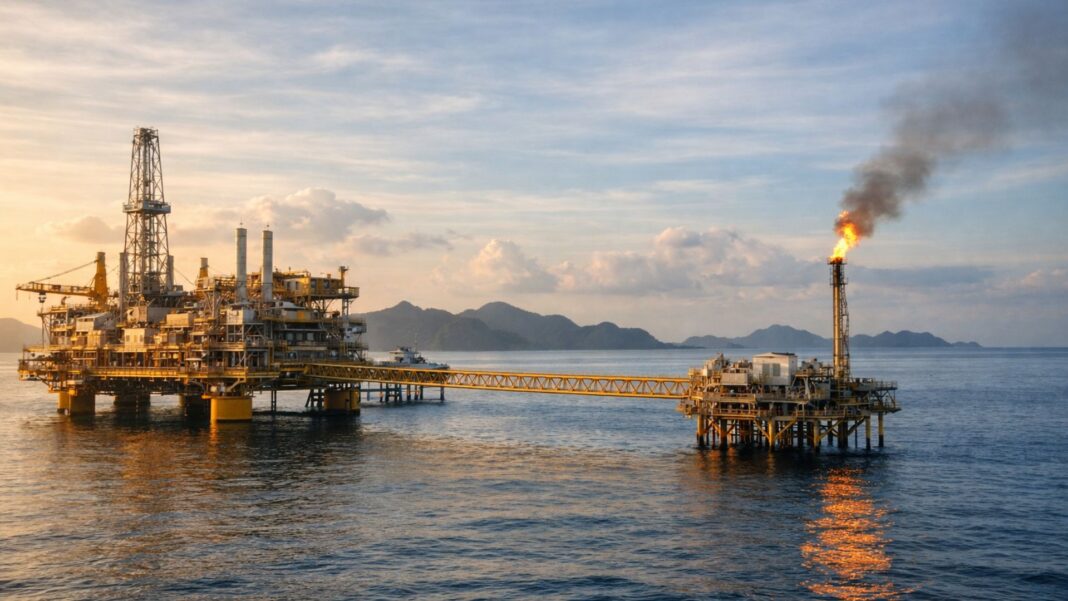

The Petroleum Association of the Philippines urged domestic power generation companies on March 11, 2026 to maximize the use of indigenous natural gas from the Malampaya field rather than rely on imported LNG, citing a cost differential of more than ₱5.50 per kilowatt-hour between the two sources. The call came as the country’s Department of Energy warned of a potential 16% increase in electricity rates by April, driven by the disruption of Qatari LNG exports following the closure of the Strait of Hormuz.
Key Facts At A Glance
- PAP Chairperson Donnabel Kuizon Cruz made the call at a Senate hearing on March 11, 2026
- Malampaya-sourced electricity currently costs approximately ₱4.80 per kWh, versus ₱10.30 per kWh for imported LNG
- The LNG price cited by Cruz represents a cost more than double that of domestic gas-fired generation
- Republic Act No. 12120, the Philippine Natural Gas Industry Development Act, exempts indigenous natural gas and the electricity it generates from value-added tax under Section 38
- DOE Secretary Sharon Garin separately warned on March 9 that global LNG prices have already risen from approximately ₱12 to over ₱25 per unit
- Malampaya has supplied approximately 20% of Luzon’s electricity needs since 2001; its operator, Prime Energy Resources Development B.V., confirmed a new gas discovery at the Malampaya East-1 reservoir in January 2026, boosting the field’s remaining recoverable volumes by an estimated 30%
- The Philippines’ DOE is in talks with the government to explore emergency market intervention powers to limit the pass-through of global fuel prices to consumers
The Petroleum Association of the Philippines publicly pressed power generation companies to prioritize domestic natural gas over imported liquefied natural gas at a Senate hearing on March 11, 2026, as global fuel price volatility triggered by the Strait of Hormuz closure sharpened attention on the Philippines’ exposure to import-dependent generation.
PAP Chairperson Donnabel Kuizon Cruz, who also serves as president and chief executive officer of Prime Energy Resources Development B.V. — the operator of Service Contract No. 38 covering the Malampaya Deep Water Gas-to-Power Project — told senators that the country’s indigenous gas capacity remains underutilized despite its clear price advantage. Electricity generated using Malampaya gas costs approximately ₱4.80 per kilowatt-hour, compared with approximately ₱10.30 per kilowatt-hour for power generated from imported LNG. That differential — more than ₱5.50 per kWh — represents a direct pass-through cost to consumers and distribution utilities when domestic supply is not prioritized.
The Legislative Angle
Cruz grounded her appeal in Republic Act No. 12120, the Philippine Natural Gas Industry Development Act, which was signed into law in 2025. The PAP’s position is that full implementation of the statute represents a more durable remedy to fuel price volatility than the temporary petroleum tax suspensions being debated in the same Senate session. Section 38 of the law explicitly exempts the sale of indigenous natural gas and the electricity generated from it from value-added tax, a provision Cruz said could yield additional household savings if gas generators maximized drawdowns from Malampaya rather than importing LNG at spot prices.
The push came as Energy Regulatory Commission Chairman Francis Saturnino Juan separately told reporters on the sidelines of the 2026 Philippine Electric Power Industry Forum in Baguio City that WESM spot prices could rise by as much as ₱2 to ₱4 per kilowatt-hour in April, based on simulations run by the Independent Electricity Market Operator of the Philippines. DOE Secretary Sharon Garin, speaking to Reuters on March 13, confirmed the government was seeking emergency powers to intervene in one of Southeast Asia’s few unregulated power markets, adding that distribution utilities had already offered to ramp up coal-fired generation to replace LNG volumes lost to the Hormuz disruption.
Malampaya’s Position And The Indigenous Supply Case
The Malampaya gas field offshore Palawan has supplied Philippine power plants since 2001. Prime Energy confirmed in January 2026 that drilling at the Malampaya East-1 reservoir had yielded a commercially viable gas find — the country’s first in over a decade — confirming 98 billion cubic feet of additional natural gas and boosting the field’s remaining recoverable volumes by an estimated 30%. Cruz referenced this discovery at the Senate hearing as evidence that the 2022 government decision to extend Service Contract 38 to 2039 had already produced tangible supply results.
Malampaya currently accounts for approximately 20% of Luzon’s electricity supply, delivered to four power plants on the island. The consortium is led by Prime Energy alongside UC38 LLC and state-run PNOC Exploration Corporation. Cruz noted that despite the field’s output, power plants in the Luzon grid are absorbing imported LNG at the current inflated spot price when Malampaya volumes could be substituted or blended, and that the DOE was actively coordinating with the sector to reconfigure the fuel mix in response to the crisis.
Broader Context
The Philippines’ LNG dependence is structurally layered. More than 80% of the country’s coal supply is also imported, meaning the grid’s exposure to global commodity volatility is not limited to gas. Electricity tariffs in the archipelago are already the second highest in Southeast Asia, behind Singapore. With the dry season approaching — a period that historically drives peak demand on the Luzon grid — the compounding of fuel import costs, WESM price pressure, and ancillary service charges creates a materially adverse outlook for consumer electricity bills in the near term.
The DOE confirmed on March 13 that it was simultaneously in talks with Indonesia to secure coal supply continuity, and with First Gas Power Corporation regarding the availability of any uncommitted indigenous gas volumes for plants currently running purely on LNG. No agreement had been publicly confirmed at the time of this report.