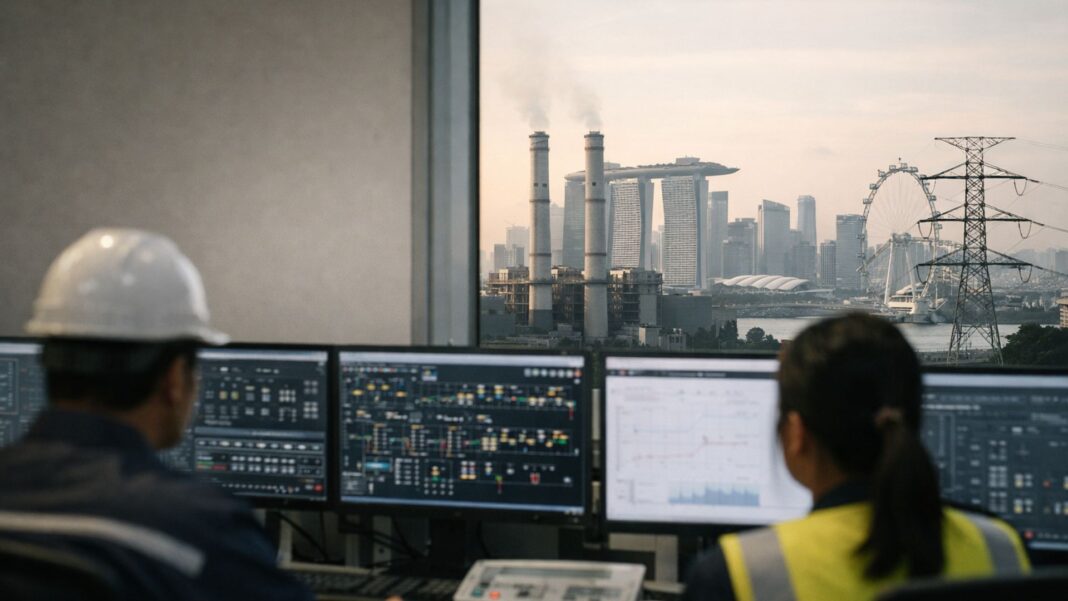

Singapore’s Energy Market Authority issued a formal warning on March 5, 2026 that the Middle East conflict is likely to raise global energy prices and push up domestic electricity costs, after a drone strike on QatarEnergy’s Ras Laffan export complex forced a production halt that tightened Asia-Pacific gas supply to its tightest level since 2023. Singapore, which generates more than 90% of its electricity from imported natural gas, faces a potential Q2 2026 tariff increase through its quarterly price adjustment mechanism, though most retail consumers remain shielded in the near term by fixed-price contracts.
Key Facts At A Glance
- Singapore generated approximately 95% of its electricity from imported natural gas as of 2026, according to the Energy Market Authority
- In 2025, Singapore imported 6.04 million tonnes of LNG, of which approximately 42.5–47% originated from Qatar, per Global Trade Tracker and Rystad Energy data
- Singapore’s gas supply comprised 43% piped natural gas from Malaysia and Indonesia and 57% LNG from global sources, per EMA
- Singapore receives two to three Qatari LNG cargoes per month, most covered by long-term contracts; spot procurement is required if those shipments are disrupted
- The current Q1 2026 regulated electricity tariff is 26.71 cents per kWh before GST, or 29.11 cents per kWh inclusive of GST, per EMA’s official tariff schedule
- SP Group raised electricity tariffs by 10% in Q2 2022 following the Russia-Ukraine gas supply shock
- Asian LNG spot benchmark prices more than doubled to above USD 24/MMBtu by March 5, 2026, the highest since January 2023, per Argus Media
- EMA’s 2023 temporary price cap mechanism acts as a wholesale market circuit breaker during periods of sustained volatility
Singapore’s Energy Market Authority Warns Of Higher Power Bills As Qatar LNG Halt Squeezes Supply
Singapore’s energy regulator issued one of its starkest supply warnings in years on March 5, 2026, telling households and businesses that the Middle East conflict is likely to raise global energy prices and, with them, domestic electricity costs. The advisory came three days after QatarEnergy suspended liquefied natural gas production at its Ras Laffan industrial complex in Qatar following drone and missile strikes, removing approximately 20% of global LNG export capacity from the market overnight.
The city-state sits at the sharp end of the disruption. Singapore generates roughly 95% of its electricity from imported natural gas, making it one of the most gas-dependent power markets in the world. Of the 6.04 million tonnes of LNG it imported in 2025, approximately 42.5–47% came from Qatar, according to data from Global Trade Tracker and independent estimates by Rystad Energy. That translates to two to three Qatari cargoes arriving in Singapore every month, the majority of which are covered by long-term supply contracts.
The Tariff Mechanism And What It Means For Bills
Singapore’s regulated electricity tariff is set quarterly by SP Group, the state-owned grid operator, based on the average of daily natural gas prices recorded during the first two-and-a-half months of the preceding quarter. The formula means that a sustained fuel price shock in March, April, and May would flow directly into the Q3 2026 tariff revision, announced in late June and effective from July 1. A partial impact on the Q2 2026 tariff covering April through June is also possible depending on how gas prices behaved in January through mid-March.
The current Q1 2026 regulated tariff stands at 26.71 cents per kWh before Goods and Services Tax, equivalent to 29.11 cents per kWh inclusive of GST, per the EMA’s official tariff schedule. The most directly comparable historical episode is Q2 2022, when SP Group raised electricity prices by 10% following Russia’s invasion of Ukraine, which triggered the last major global gas supply shock. Asian LNG spot benchmark prices assessed by Argus Media via the ANEA indicator crossed USD 24 per million British thermal units on March 5, 2026, more than doubling within a week to their highest level since January 2023. Qatar’s own Energy Minister Saad al-Kaabi told the Financial Times around the same period that spot LNG prices could approach USD 40/MMBtu if the disruption proves prolonged.
EMA confirmed to media on March 5 that it was monitoring the situation and that sustained high fuel costs would result in higher tariffs in subsequent quarters.
Near-Term Consumer Protection
EMA was explicit that most consumers are not immediately exposed. The regulator noted that households and businesses purchasing electricity through fixed-price retail contracts or SP Group’s regulated tariff are shielded from immediate wholesale market swings. The tariff formula’s built-in averaging mechanism further dampens short-term price spikes. However, EMA indicated that consumers may see higher prices at the point of contract renewal if fuel costs remain elevated over a prolonged period.
The regulator also pointed to a series of resilience measures introduced since 2021. These include a standby LNG facility that power generation companies may draw upon if incoming gas supplies are disrupted, mandatory fuel reserve requirements for generators calibrated to their available capacity, a diesel stockpile maintained as backup fuel, and a temporary wholesale price cap mechanism introduced in 2023 to function as a circuit breaker during periods of high and sustained volatility in the Uniform Singapore Energy Price. The USEP reached S$491 per megawatt-hour in October 2021 and S$492 per MWh in May 2023 during the prior crisis cycle, per historical data cited by multiple local outlets.
Singapore GasCo: First Real Test
The Qatar shutdown marks the first operational test of Singapore GasCo Pte Ltd, the fully government-owned entity established in 2024 under the EMA to centralize LNG procurement for the power sector. GasCo’s Chief Executive Alan Heng stated at the Singapore International Energy Week in October 2025 that the entity would be operationally ready by January 1, 2026, with contingency protocols in place for large supply disruptions. GasCo’s mandate is to act as the sole upstream gas procurer for Singapore’s power generators, giving it greater negotiating leverage and the ability to manage supply gaps through spot procurement.
As of early March 2026, GasCo had declined to comment on commercial matters related to the disruption. Rystad Energy analyst Lu Ming Pang noted that Singapore’s relatively modest import volumes compared with major buyers like Japan, South Korea, and China meant the city-state stood a reasonable chance of sourcing replacement cargoes. The caveat, he said, was cost: any replacement volumes would come at the elevated spot prices now prevailing in Asian markets. Singapore would need to compete against buyers from across Asia and Europe drawing on the same limited pool of non-Qatari cargoes, as well as absorbing war-risk premiums and vessel re-routing costs flowing from Strait of Hormuz disruptions.
Structural Exposure
The episode highlights the structural exposure embedded in Singapore’s energy model. Unlike most Southeast Asian economies that rely on a mix of coal, hydropower, and gas, Singapore has consolidated its power generation almost entirely around natural gas, a deliberate policy choice tied to air quality, carbon intensity, and grid efficiency goals. That concentration has delivered clean, reliable, and competitively priced power through periods of stable LNG markets. It creates acute vulnerability when a single major supplier is suddenly removed from the market.
Deputy Prime Minister Gan Kim Yong said around the same period that a prolonged conflict in the Middle East could force Singapore to reassess its GDP growth forecasts, underscoring the linkage between energy security and macroeconomic stability in a city-state with no domestic energy resources of its own.