

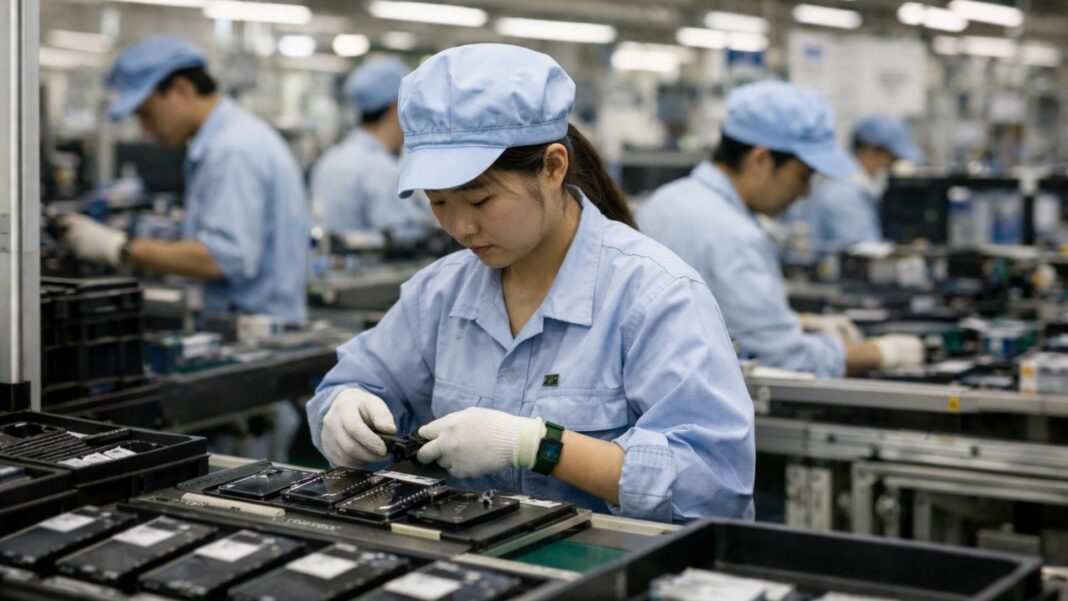

Vietnam’s realized foreign direct investment in the first two months of 2026 reached $3.21 billion, an 8.8% increase year-on-year and the highest two-month FDI disbursement figure the country has recorded in five years. South Korea and Singapore were the two dominant investor nations by newly registered capital, reinforcing Vietnam’s standing as the primary manufacturing relocation destination in Southeast Asia amid continuing global supply chain restructuring.
Key Facts At A Glance
- Realized FDI for January–February 2026: $3.21 billion, up 8.8% year-on-year
- Five-year high for the January–February period, surpassing all comparable readings from 2022 through 2025
- Manufacturing and processing sector absorbed $2.65 billion, or 82.7% of total disbursed FDI
- Real estate activities received $223.5 million (7%); electricity and gas supply received $119.2 million (3.7%)
- South Korea was the largest investor by newly registered capital: $1.34 billion, or 37.8% of the total
- Singapore was second: $1.1 billion, or 31.1% of newly registered capital
- China ranked third with $522.8 million (14.8%); Japan fourth with $171 million (4.8%)
- Total registered FDI capital for the two months: $6.03 billion across 620 new projects, with newly registered capital up 61.5% year-on-year
- Thai Nguyen province led all provinces in attracted FDI capital at nearly $1.7 billion, a 1,354% increase year-on-year
- Ho Chi Minh City received $900.2 million; Bac Ninh $818.5 million; Hanoi $624.52 million
Vietnam’s General Statistics Office, operating under the Ministry of Finance, released the two-month FDI data in the first week of March 2026. The figures confirm that realized foreign investment — the measure of capital actually deployed into operations — reached its highest January–February level since at least 2022.
Manufacturing Dominates Capital Flows
The manufacturing and processing sector continued to account for the overwhelming share of both disbursed and newly registered foreign capital. Of the $3.21 billion in disbursed FDI, $2.65 billion — equivalent to 82.7% — flowed into manufacturing and processing, consistent with Vietnam’s structural role as an export-oriented industrial hub. The sector also led in newly registered capital with $2.63 billion, or 74.3% of total newly registered FDI, followed by wholesale and retail trade at $358.6 million and all other sectors combined at $550.5 million.
The full-year 2025 FDI disbursement figure provides important context: Vietnam recorded $27.62 billion in implemented FDI capital for all of 2025, itself the highest annual level in five years, up 9% year-on-year (tradingeconomics.com). The January–February 2026 data indicate that momentum has carried into the new year without interruption.
South Korea And Singapore Lead Committed Capital
Among 44 countries and territories registering new investment projects in Vietnam during the first two months of 2026, South Korea recorded $1.34 billion in newly registered capital, representing 37.8% of the national total (vietnam.vn). Singapore followed with $1.1 billion, or 31.1%. These two markets together accounted for nearly 69% of all newly registered FDI capital for the period.
South Korea’s sustained investment position reflects the deep manufacturing footprint anchored by Samsung Electronics, which operates four major subsidiaries in Vietnam producing over half of Samsung’s global smartphone output. Thailand Nguyen province, home to Samsung’s largest Vietnam facilities, posted a 1,354% year-on-year surge in attracted FDI to nearly $1.7 billion — the highest figure among all 34 provinces and cities tracked for the period.
Singapore’s position as the second-largest source of newly registered capital reflects both direct corporate investment and the role of Singapore-incorporated entities as conduits for regional and international capital into Vietnam’s industrial zones and real estate sector. A Singaporean investor was responsible for one of January 2026’s single largest individual transactions: a $380.1 million stainless steel plant project in Ha Tinh province.
Geographic Distribution Of FDI Inflows
Beyond Thai Nguyen’s standout performance, Ho Chi Minh City attracted approximately $900.2 million in the two-month period, positioning it as the second-largest FDI destination by city (vietnam.vn). Bac Ninh, a northern province that serves as a key technology manufacturing cluster for Samsung, LG, and Foxconn, followed with $818.5 million. Hanoi received $624.52 million. The top ten provincial and city destinations combined accounted for approximately 94% of total registered foreign investment capital for the period.
The data showed 620 newly licensed investment projects for the two months, an increase of 20.2% in project count year-on-year. The average size of new projects is rising, consistent with the national government’s stated preference for attracting higher-value, technology-intensive investments rather than prioritizing volume.
Structural Context: Why The Numbers Matter
Vietnam’s FDI performance occurs against the backdrop of accelerating global supply chain diversification away from China. The country has received sustained industrial investment from technology, semiconductor, and consumer electronics multinationals, including Intel, Samsung, LG, Amkor Technology, BE Semiconductor Industries, and Foxconn — and is widely regarded as the primary beneficiary of the “China Plus One” sourcing and manufacturing strategy adopted by U.S. and European companies.
The February 2026 activation of Circular No. 08/2026/TT-BTC, which removed the 100% pre-funding requirement for foreign institutional investors in Vietnam’s securities market, adds a parallel dimension: capital market liberalisation is now running alongside industrial FDI growth, and Vietnam’s anticipated FTSE Russell reclassification to Secondary Emerging Market status in September 2026 is expected to add a further wave of portfolio investment on top of the existing manufacturing-led FDI base.
The General Statistics Office’s Foreign Investment Agency cautioned that a 12.6% decline in total registered capital for the two-month period, compared with the same period last year, should not be interpreted as a weakening trend. Officials noted the year-on-year decline was primarily driven by a sharp drop in the capital adjustment component for existing projects, which had registered an exceptionally large figure in the comparable 2025 period, rather than any reduction in new project approvals or investor confidence.