

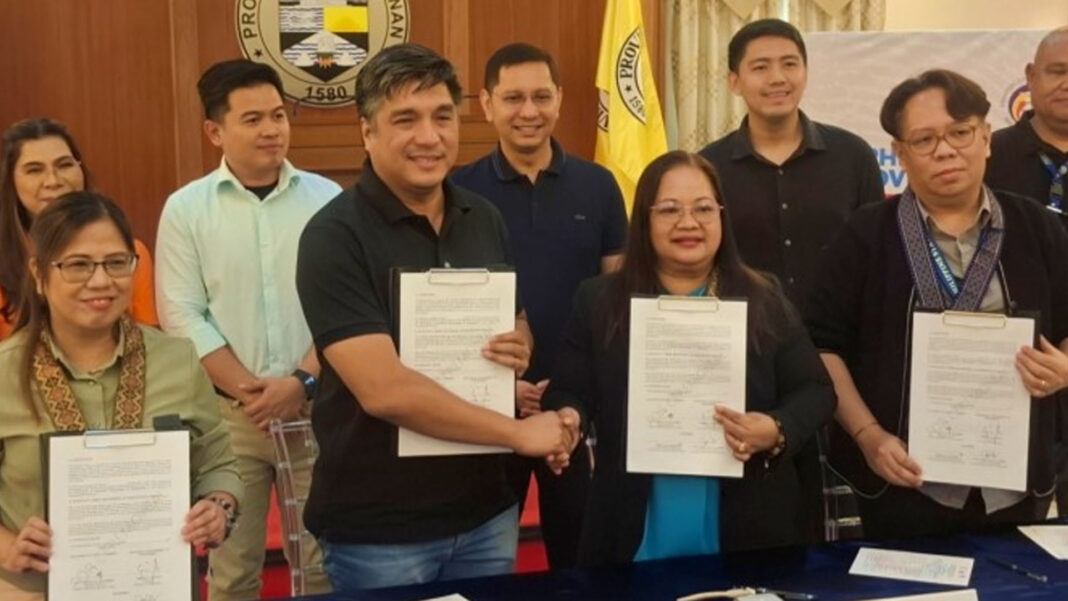

The Pangasinan provincial government and the Philippine Statistics Authority (PSA) signed a memorandum of agreement on Tuesday to establish the National Identification (ID) Integrated System, aiming to develop a collaborative, efficient, and accessible registry and related services.
Pangasinan Governor Ramon Guico III, in an interview, said the program includes the National ID Authentication Services, enrollment in the Philippine Identification System (PhilSys), the province’s medical missions, and the Government Unified Incentives for Medical Consultations (Guiconsulta) Plus.
The program also includes the setup of local government unit (LGU)-operated civil registration services (CRS) and the implementation of the Community-Based Monitoring System (CBMS).
“Basically, what will happen is we will bring the PhilSys registration to the barangays through the Guiconsulta Plus. It is a subscription contract. So basically, this is the National ID Authentication Services,” he said.
The National ID Authentication Services is a tool for identity verification of individuals using facial recognition, fingerprint scanning, or other unique credentials, including their National ID Card Number, to ensure security and minimize the risk of fraudulent activities in transactions, according to PSA.
“So, our data from the PSA and even data from other agencies like the Philippine Health Insurance Corporation would all be integrated. We can authenticate the National ID, and it would be registered to all the systems, including the provincial government system,” he said.
PSA Ilocos Region director Sheila De Guzman said national ID authentication services across social protection programs enable real-time verification and help prevent fraud.
“We are not just collecting names here; we are verifying identities. The national ID authentication confirms who is actually being served as we enhance the integrity of the entire system,” she said.
De Guzman said the integration also makes tasks easier for frontliners as identity verification becomes quicker and more reliable, reducing paperwork and shortening the processing time.
“In health-related services, efficiency is vital. So, through collaboration between the PSA and implementing agencies, digital tools continue to evolve, helping local governments deliver programs more effectively and responsibly,” she said.
Under the program, the setup of LGU-operated CRS is included.
Guico said they plan to establish CRS offices in Lingayen, Binalonan, and Alaminos City, in addition to the existing offices in Calasiao and Rosales towns.
“In these offices, they may process their birth certificates, death certificates, marriage certificates, and others they want to process with PSA,” he said.
The other program component is the CBMS, which they would implement as Guiconsulta Plus reaches the villages.
CBMS is a technology tool for collecting, processing, and validating local data. It provides LGUs with actionable data for poverty reduction, program implementation, and planning, including geotagging facilities, per the Department of the Interior and Local Government.
Guico said through the CBMS, the data and profiling are updated annually.
In the Ilocos Region, the province of Ilocos Norte is the first to enter into this agreement. (PNA)