

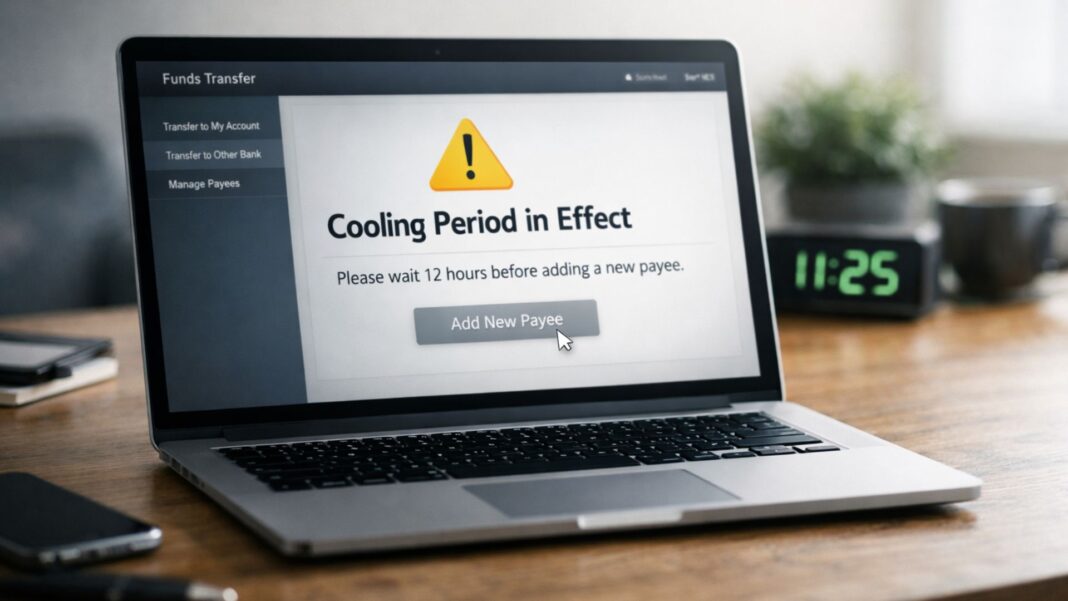

DBS Bank activated a 12-hour cooling period on March 7, 2026, requiring customers to wait before new payees are added, daily transfer limits are raised, or registered contact details are updated — changes that were previously processed instantly. The measure, announced to customers on February 20, 2026, forms part of Singapore’s industry-wide response to scam losses that reached nearly S$500 million in the first half of 2025.
Key Facts At A Glance
- Effective date: March 7, 2026; announced to DBS customers via email on February 20, 2026
- Three transaction types now subject to the 12-hour delay: adding new transfer recipients, increasing daily local and overseas transfer limits, and updating registered contact details
- During the cooling period, alerts are sent to the customer’s bank-registered contact details for review
- Singapore Police Force data released in August 2025 showed nearly S$500 million lost to scams in the first half of 2025, with close to 20,000 cases reported
- Phishing scams were the most common type, with 3,779 cases and S$30.4 million in losses in H1 2025 — a 134 percent increase from the S$13 million recorded in the same period in 2024
- OCBC implemented a similar 12-hour cooling period in 2022; UOB followed in December 2024
- The Monetary Authority of Singapore and the Infocomm Media Development Authority’s Shared Responsibility Framework took effect on December 16, 2024, mandating cooling periods as a formal duty for financial institutions
The Measure And What It Covers
From March 7, 2026, DBS Bank digital banking users are no longer able to instantly add a new transfer recipient, raise daily transfer limits for local or overseas transactions, or update contact details such as email addresses and mobile phone numbers. Under the new policy, these changes are placed on hold for 12 hours before they take effect.
In its February 20 email to customers, DBS stated that the cooling period is designed to give customers and the bank time to detect and stop unauthorized account activity. If a scammer attempts to add a payee or raise transfer limits without the account holder’s knowledge, the changes cannot be used until the waiting period has elapsed. Customers receive alerts to their bank-registered contact details during the window, allowing them to review and report suspicious requests immediately.
DBS advised customers to plan transfers at least a day in advance to accommodate the new delay, and to keep transfer limits as low as practical to minimise potential losses in the event of unauthorised access.
Industry Context And Regulatory Backdrop
The DBS cooling period is not an isolated initiative. It reflects a structured response to Singapore’s Shared Responsibility Framework, jointly developed by the Monetary Authority of Singapore and the Infocomm Media Development Authority, which took effect on December 16, 2024. The framework assigns specific duties to financial institutions and telecommunications companies in managing losses from phishing scams, adopting a waterfall approach to determine which party bears responsibility when duties are not met.
Under the framework, financial institutions are required to impose a minimum 12-hour cooling period on high-risk activities following digital token activation or new device logins. Institutions that fail to meet these obligations bear the losses arising from phishing incidents within the framework’s defined scope.
OCBC had already implemented a comparable 12-hour cooling period for adding new payees, raising transfer limits, and updating contact details since 2022. UOB extended similar controls to transfer limit increases and new recipient additions in December 2024. DBS’s March 7 activation brings all three of Singapore’s major local banks into alignment on this specific safeguard.
In October 2025, Singapore’s major retail banks — including DBS, OCBC, UOB, Citibank, HSBC, Maybank, and Standard Chartered — introduced an additional measure allowing them to hold or reject digital transfers from accounts with balances of at least S$50,000 if withdrawals exceed 50 percent of the account balance within a 24-hour period.
Scam Loss Data
Singapore Police Force mid-year scam statistics released in August 2025 recorded nearly S$500 million in losses and close to 20,000 scam cases in the first half of 2025 alone. Phishing scams, the most prevalent category, accounted for 3,779 cases and S$30.4 million in losses during the same period — a 134 percent increase from S$13 million recorded in the first half of 2024. The most common pattern involved unauthorised card transactions where victims were deceived into submitting card details and authentication codes to scammers.
Despite the scale of reported losses, the Association of Banks in Singapore noted that scam cases fell by 26 percent in the first half of 2025, with total losses declining by 12.6 percent — a trend attributed partly to earlier anti-scam measures already in place.