

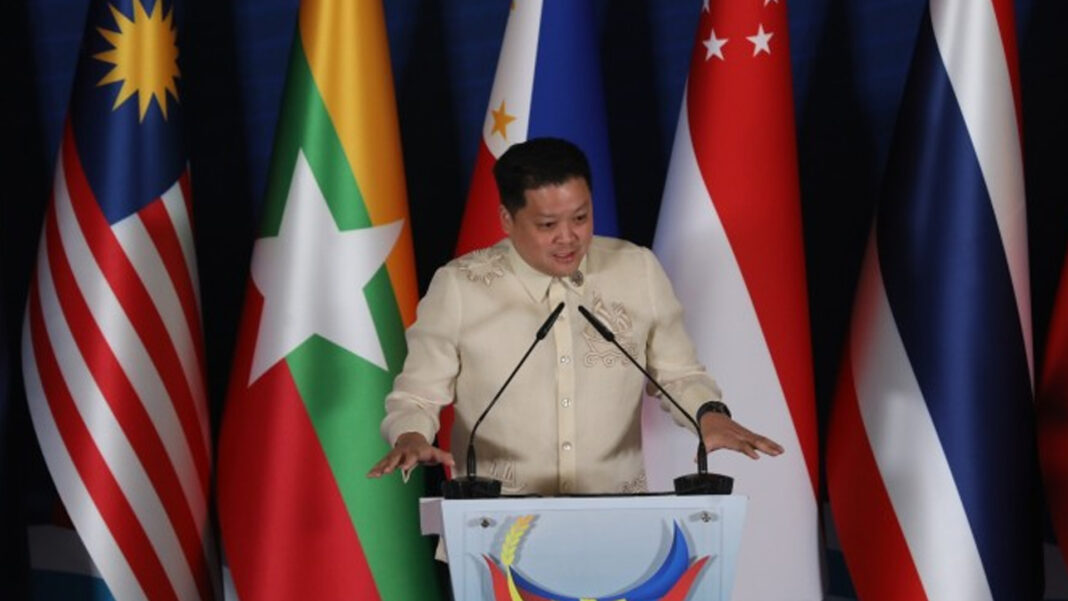

The Philippines, as this year’s chair of the Association of Southeast Asian Nations (ASEAN), is leading efforts to put people and families at the center of regional development through its “RISE” framework at the 35th ASEAN Socio-Cultural Community (ASCC) Council Meeting on Thursday.
In his opening remarks, Department of Social Welfare and Development (DSWD) Secretary and ASCC chair Rex Gatchalian emphasized the need to bolster regional cooperation as the region faces rapidly evolving challenges, technological changes, climate-related disasters, economic volatility, and social inequalities.
“At the heart of our work lies the empowerment, ensuring that our efforts translate into tangible improvements across the ASEAN community,” Gatchalian said. “This year, we focus on RISE ASEAN framework, which consists of four strategic priorities.”
He said the four priorities are Resilient and empowered families, focusing on child welfare and family support; Inclusive development, promoting equitable opportunities for vulnerable sectors; Smart youth and innovation, empowering young people with digital skills and ethical technology use; and Environmentally sustainable and food-secure future, strengthening climate resilience, disaster preparedness, and sustainable food systems across the region.
Gatchalian said that with the clear mandate from President Ferdinand R. Marcos Jr., the Philippines is committed to advancing the goal of the People Pillar of ASEAN, ensuring that ASEAN cooperation translates into meaningful improvements in the region.
Families and child welfare
Under the Resilient Families pillar, Gatchalian cited the urgent child-welfare needs in the Philippines.
He emphasized the need to establish alternative child care policies to ensure that every child grows up in a safe, nurturing, and supportive environment.
Citing data, Gatchalian noted that in the Philippines alone, more than 4,000 children are waiting to have a family, adding that these children, often victim survivors of abuse, neglect, abandonment, and exploitation, are housed in residential care facilities.
“Our goal is to advance and strengthen our adoption and alternative child care system so that no child would grow up without the love, care, and security of a family, or much worse, spend the rest of their childhood in an institution,” he said.
Aging ASEAN
Gatchalian highlighted the region’s demographic shift, noting that Southeast Asia must prepare for a rapidly aging population.
“In 2023, roughly 8.1 percent of ASEAN’s population, or 55.9 million individuals, were aged 65 and above, and this number is expected to rise in the years ahead. The emergence of an aging society is here and a key priority in advancing the silver economy,” he said.
He encourages the creation of a regional framework, with the participation of the private sector, to support active aging and protect dignity in later life.
Inclusive development, youth innovation
The Inclusive development and Smart youth and innovation priorities, Gatchalian said, aim to ensure equitable opportunities for all, while enabling the youth to lead ASEAN into a technological future.
“Investing in their participation, digital literacy, creative and ethical use of emerging innovations enable ASEAN to adapt to technological change and global shifts,” Gatchalian said.
Climate and disaster reform
Meanwhile, on environmental security, Gatchalian said the Philippines introduced the Manila-ASEAN Strategic Protocol for Emergency and Comprehensive Transformation to strengthen cross-border disaster response and coordination.
“This is a strategic initiative to strengthen ASEAN’s disaster response and enhance regional coordination. It will also signal our commitment to one ASEAN, one response, to leaving no one behind, especially sectors in the vulnerable situations,” he said.
ASEAN perspective
ASEAN Deputy Secretary General for Socio-Cultural Community San Lwin, meanwhile, described 2026 as “a landmark year” for ASEAN, which he said marks the start of a new chapter that is aligned with ASEAN 2045.
“ASEAN 2045, our shared futures, sets before us a forward-looking agenda that calls for a more integrated, cohesive, inclusive, innovative, and resilient ASEAN,” he said.
He emphasized the need for a people-centered region, adding that empowering the people is the cornerstone of ASEAN’s community-building efforts and a catalyst for regional integration.
Highlighting the increasing and evolving challenges the region faces, he noted that the people must be well-positioned to adapt to innovation and ultimately drive human-centered, inclusive, sustainable development across the region, equipping them with opportunities and resources to maximize their potential while investing in their holistic development.
“A people-centered ASEAN community should go beyond mere aspirations. It must be a core to ASEAN that shapes every policy, program, and decision we make. The measures of our progress and success lie not only on the volumes of documents we produce or the numbers of meetings and forums we convene, but in building safer, healthier, more resilient, and sustainable communities where our people can truly thrive,” San Lwin said. (PNA)