

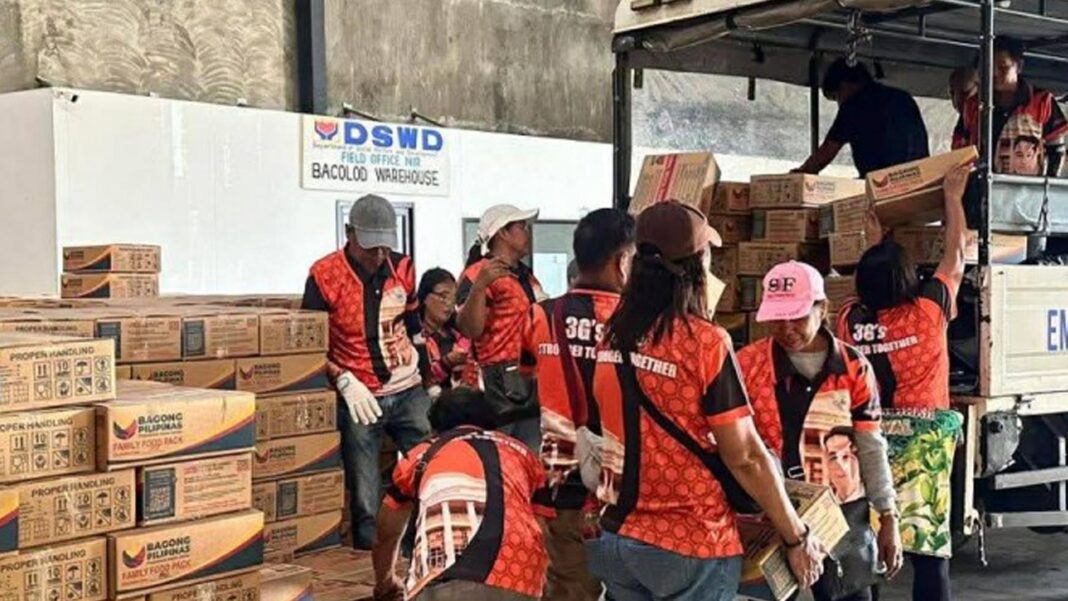

The Department of Social Welfare and Development (DSWD), through its Field Office Negros Island Region (NIR), has provided food packs to families affected by flooding incidents brought by a shear line.
“Nagkaroon po ng ‘yellow’ rainfall warning kahapon sa Bacolod City na nagdulot ng matinding pagbaha sa 24 na barangay. Sa utos ni Secretary Rex Gatchalian, maagap na nakapagpaabot ng tulong sa 320 pamilyang naapektuhan ng baha ang DSWD NIR. Nagbahagi kami ng mga family food packs (FFPs) na syang naka-preposition na sa area (A yellow warning rainfall in Bacolod City caused heavy flooding in 24 villages. On orders of Sec. Gatchalian, the DSWD NIR immediately extended assistance to 320 affected families. We also distributed FFPs that have been prepositioned in the area),” Assistant Secretary Irene Dumlao of the Disaster Response Management Group (DRMG) said on Monday.
The DSWD spokesperson said the immediate response to assist the flood-hit families is in accordance with President Ferdinand R. Marcos Jr.’s directive to ensure efficient, timely and responsive assistance to communities affected by disasters or emergencies.
She assured the public that the DSWD NIR is in close coordination with the city government of Bacolod for technical assistance or additional augmentation support to ensure that the affected households can immediately bounce back to their normal lives after the floodings subside.
“Sa mga kababayan po natin handa po ang DSWD na patuloy na magbahagi ng tuloy sa mga nasalanta ng baha. Mayroon po ang DSWD NIR na higit 230,000 FFPs na maaring i-deploy agad kung kinakailangan (The DSWD is ready to extend additional assistance the affected families. The DSWD NIR has 230,000 FFPs that can be deployed if needed),” Dumlao said.
Meanwhile, Dumlao said the DSWD continues to strengthen its disaster response capacity to disaster response through the Buong Bansa Handa (BBH) program.
The BBH program employs two parallel supply chain mechanisms for disaster preparedness and response.
The first supply chain utilizes a national and local government-driven supply chain that aims to increase the production capacities and processes of the agency’s Luzon Disaster Resource Center (LDRC) in Pasay City, the Visayas Disaster Resource Center (VDRC) in Cebu, and the warehouse and storage facilities across all DSWD’s field offices.
The second supply chain, on the other hand, focuses on the DSWD’s partnerships with the private sector to tap the expertise and resources of established large and small groceries, supermarkets, manufacturers, and distributors.
“By employing these supply chains, the DSWD’s regional offices are able to respond immediately to requests by local government units for augmentation support during disasters,” Dumlao said. (PNA)