

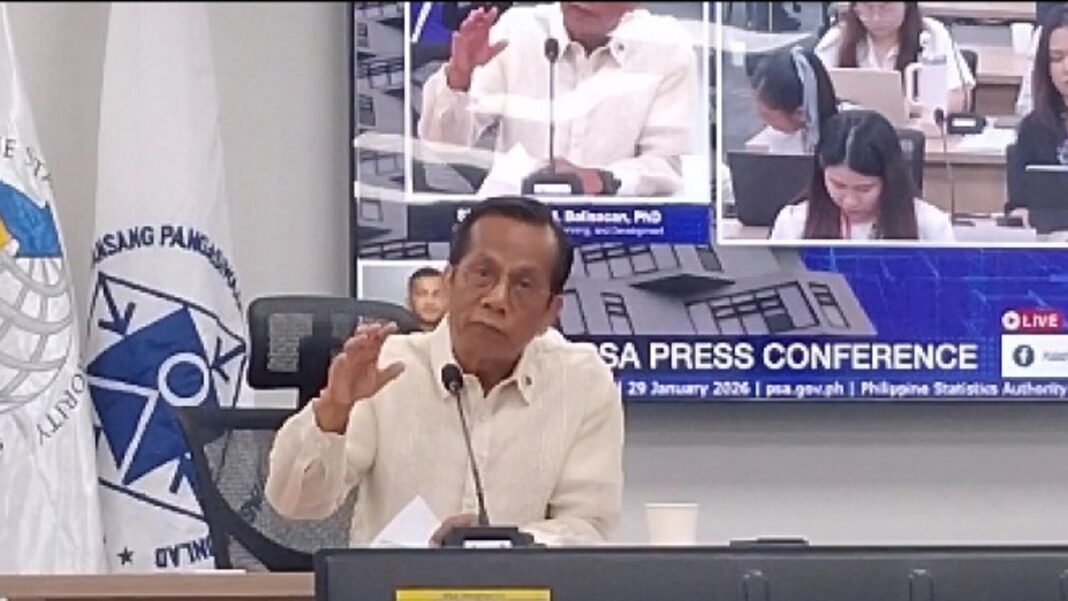

The impact of government measures to support domestic economic growth is expected to begin materializing in the second quarter of 2026, Department of Economy, Planning and Development (DEPDev) Secretary Arsenio Balisacan said Thursday.
Balisacan made the statement after the Philippine economy grew by 3 percent in the fourth quarter of 2025, slower than the 3.9 percent in the previous quarter and the 5.3 percent recorded a year earlier, according to the latest Philippine Statistics Authority (PSA) data.
The PSA said full-year growth settled at 4.4 percent, below the 5.7 percent posted in 2024 and under the revised 4.8 to 5 percent target.
On the demand side, fourth-quarter exports of goods rose 22.8 percent, imports of services increased by 4.2 percent, household consumption grew by 3.8 percent, and government spending expanded by 9.1 percent.
For the full year, exports of goods grew by 14.1 percent, government consumption by 9.1 percent, imports of services by 6.1 percent, and imports of goods by 4.7 percent.
The government targets GDP growth of 5 to 6 percent this year and 5.5 to 6.5 percent in 2027, with export growth targets of 2 percent and 3 percent, respectively. The foreign exchange assumption for both years is PHP58.60 to a US dollar.
In a briefing, Balisacan said a return to at least 5 percent growth is possible by the second quarter, noting that achieving the full-year target would require growth to reach that level by then.
“That’s the goal anyway, to go to the five to six percent for the entire year. On exactly what month or quarter, it’s something definitely I couldn’t say but, yes, to be able to go to 5 to 6 percent, you have to grow 5 percent by Q2,” he said.
He attributed the slowdown to weather- and climate-related disruptions, issues surrounding anomalous flood control projects, and global economic uncertainties, which dampened construction activity and private consumption. Domestic demand growth slowed to 0.7 percent in the fourth quarter, while full-year expansion reached 3.7 percent.
Balisacan stressed the need to restore investor and consumer confidence through governance reforms, stronger accountability, improved project quality, and better use of public funds.
He also cited the importance of improving disaster preparedness, early warning systems, and the capacity of the state weather bureau.
For infrastructure, he said the government will accelerate the completion of ongoing projects while strengthening anti-corruption safeguards to support economic recovery and achieve more sustainable growth.
“These reforms protect public funds, strengthen our institutions, build a more resilient, inclusive economy, and ultimately, rebuild trust between government and the people we serve,” Balisacan said. (PNA)