

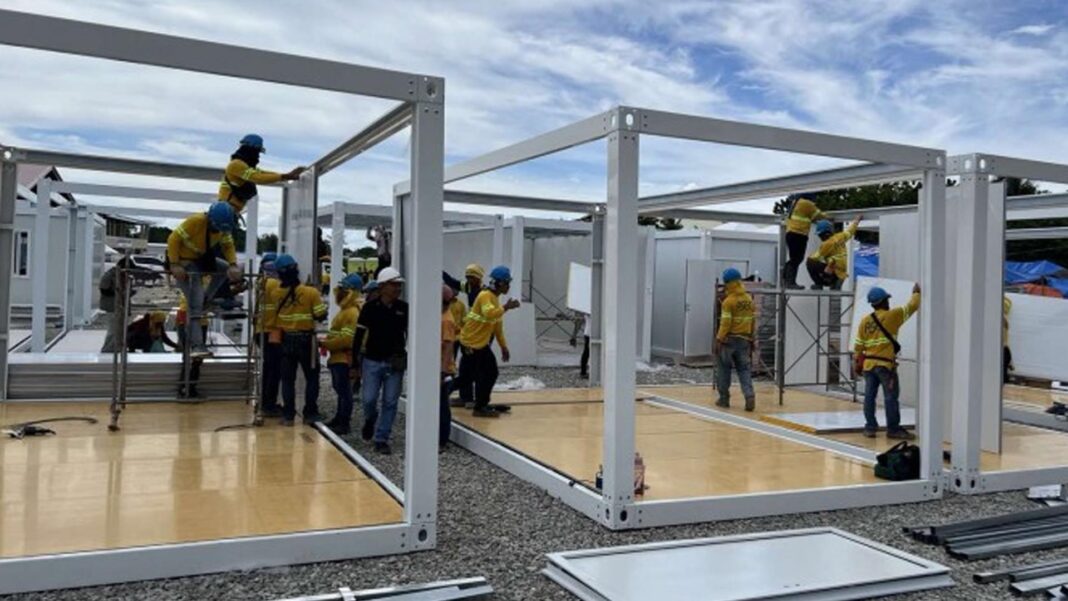

The Department of Human Settlements and Urban Development (DHSUD) has expanded the deployment of modular shelter units (MSUs) to disaster-hit areas in 2025, raising the standards of transitory housing.
In a news release Friday, the agency noted that the initiative aims to offer secure and humane temporary housing for families displaced by calamities through coordination with national agencies, local government units (LGUs) and partner stakeholders.
In October, the DHSUD under the leadership of Undersecretary Ed Robles and partner agencies launched Bayanihan Villages, or clusters of MSUs, initially in areas affected by strong earthquakes in Cebu and Davao Oriental provinces.
As of Dec. 12, MSUs have been fully deployed in San Remigio, Daantabayan and Bogo in Cebu, as well as in Tarragona and Manay in Davao Oriental, providing immediate shelter to families whose homes were damaged or destroyed.
In San Juan City, the DHSUD turned over MSUs now occupied by fire victims. The units will serve as a staging area for beneficiaries of the expanded 4PH program.
Installation of additional MSUs is ongoing in Bogo, Baganga and Mandaue City in Cebu, and in Tarragona and Baganga in Davao Oriental.
More shelters are also allotted for Mandaue City as continuing support for LGUs affected by recent typhoons.
Pending Mines and Geosciences Bureau inspection, deployments are also underway in parts of Cebu, Davao Oriental, Camarines Sur, Albay, Catanduanes, Negros Occidental and Negros Oriental.
“Each MSU deployed represents a real family—parents, children, and the elderly—who urgently need shelter after disasters,” DHSUD Secretary Jose Ramon Aliling said.
“These units are not just temporary roofs. They are safe, orderly, and dignified shelters while communities recover.”
He added that DHSUD would continue improving facilities inside Bayanihan Villages, including health clinics and training and learning centers, to support the rehabilitation of displaced families. (PNA)